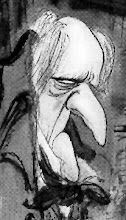
Concerning a great poet, two politicians -- one noble, progressive and thoughtful, the other low, devious and conniving -- and a worthy local benefactor.

Famously, Robert Browning is alleged to have got it wrong, too:
But at night, brother Howlet, far over the woods,Malcolm has never been fully convinced that wasn't a disingenuous double-bluff by Browning. There always seemed to Malcolm to be a bit too much of the ambiguous Freudian sub-conscious in that bit (night, sisterhoods, gallantry, monks and nuns ... ) to be wholly straight-forward.
Toll the world to thy chantry;
Sing to the bats’ sleek sisterhoods
Full complines with gallantry:
Then, owls and bats, cowls and twats,
Monks and nuns, in a cloister’s moods,
Adjourn to the oak-stump pantry!
Added to which, the entire "plot" of Pippa Passes (which dates from 1841) involves the maidenly young miss skipping unharmed and unmolested through some steamy, seamy bits of the Veneto. Browning may have lived through most of the Victorian period, and thereby forever designated a "Victorian", his mother may have been devout and evangelical, but his father had a large and polyglot library. Large chunks of Pippa Passes are a long way from the innocent, as with ‘Zanze from the Brenta:

I have made her gorge polentaThink about that. And it immediately precedes the more-frequently visited quotation above. Very suspicious!
Till both cheeks are near as bouncing
As her . . . name there’s no pronouncing!
See this heightened colour too—
For she swilled Breganze wine
Till her nose turned deep carmine—
’Twas but white when wild she grew
And only by this Zanze’s eyes
Of which we could not change the size,
The magnitude of what’s achieved
Otherwise, may be perceived!’
Even so, the Oxford English Dictionary has no qualms in defining Cameron's usage as:
low slang ... A term of vulgar abuse. Cf. TWIT and CUNT.So, that let's the People's Dave off the hook, does it?
Well, not if we go with the first citation in the OED, from Eric Linklater's Magnus Merriman, which seems to have the boy bang to rights:
He was ... a false hero who flaunted himself in fine colours when he was drunk and dwindled to a shabby twit when sober.Ah yes, the true, the blushful Bullingdonian.
The other aspect of the OED entry deserves a bit of thought. Elsewhere, the OED has no scruples about defining terms for "the female external genital organs" (which, typically, is a male-chauvinist construct: it may be visually, but hardly gynaecologically correct ). In this entry, there's not even so much help: was the word just too racy for Doctor James Murray?
Curiouser and curiouser, said Alice.
Alice will be gracing us with a personal appearance a bit later on in this posting.The usual explanation of Browning's usage is that, in the final decade of his life (we are now into the High Victorian age), the Great Man received a letter from the newly-conceived Oxford English Dictionary, and was politely challenged to explain himself.

Doubtless harrumphing a little to be required to think back four decades, Browning came up with a fine excuse -- one that has misled many over the intervening years, and which Malcolm will now correct.
Browning had, he replied, in his youth read seventeenth-century verse in his father's library. A piece from 1659 (Vanity of Vanities or Sir Harry Vanes Picture: To the tune of the Jews Corant) was his particular source. Happily we cyber-searchers can see a copy of this is on-line at U. Penn: indeed, it includes the key couplet:
They talk’t of his having a Cardinall’s Hat;This, averred Browning, was what had misled him.
They’d send him as soon an Old Nun’s Twat.
A Vane aside
That scurrilous broadside is worth further consideration.
Vane had followed John Pym as leader of the Parliamentarians. He consistently tried to reach accommodations with Charles I. Vane drifted to the radical "Independents", taking positions against the "Presbyterians", mainly in defence of freedom of conscience. He wished to retain a monarchy, and would not vote for the King's execution. He broke with Cromwell over a reform of voting rights and Parliamentary control of the army.
He was, in effect, sent into internal exile at Raby Castle. His further writings (which recapitulated his proposals for electoral reform, including the creation of a Senate) caused him to be identified with the extremist Anabaptists. He was summoned to appear before the Council, refused, was ordered to put up the then-outrageous £5,000 in sureties for his future behaviour, refused again (and was probably incapable of finding such a sum), and was imprisoned at Carisbrooke.

Under Richard Cromwell, "Tumbledown Dick", Vane (right) was back at the centre of politics. By May 1659 (the time of this broadside) he was effectively running the armed services and the treasury.
At first excluded from the Restoration "hit list", the Cavalier Parliament then demanded Vane be tried for High Treason. There was a show trial; and Vane was condemned. Pepys recorded witnessing his speech from the scaffold and his beheading (14 June 1662).
Vane was briefly governor (1636-7) of the Massachusetts Bay Colony. He was responsible for the purchase of Rhode Island, and is thereby the begetter of Harvard. His statue stands on the left as one enters the Boston Public Library.
They'd ςend him as ςoon an Old Nun's Twat
Malcolm find the font cannot do the the original long "s" there. More to the point, he doubts that Browning can have been ignorant of the tone of the broadside. The conceit is that Vane was "holier-than-thou":
The Annointed King of Saints,who
fell in a T[urd] when aςide he ςtept.We also hear the target of this crude lampoon:
He durςt not speak of a Concubineand (work out the implication, here, yourselves -- please!):
He ςhall undergo a notable Swindging, There is no more need of his Engine.The whole tone is so extreme, so crude, so of the earth, earthy, that a sensitive exponent of language (as Browning most assuredly was) cannot easily have assumed the simplistic here.
Neither was Diddy Dave Cameron quite the innocent in his radio interview. This is a man with considerable PR and media experience. Add to that an Oxford degree of some distinction. Therefore, his assertions of moon-faced ignorance do not wash. It was a cheap shot for a tissue of publicity.
A sweet little Alice bluestocking
We are not in Wonderland, nor yet in Kansas anymore, but in Knott County, Kentucky.
There we find the small town of Pippa Passes:
Population in July 2007: 291.[Editor: Shurely shome mistake? ... ]
Males: 56 (19.5%)
Females: 235 (80.5%)
Median resident age: 20.8 years
Kentucky median age: 35.9 years
It has this quite astounding demography because it is the seat of Alice Lloyd College, where presumably the male of the species is dormitoried out-of-town, well away from the young ladies.
Malcolm promised the return of Alice. Alice Spencer Geddes Lloyd, a Bostonian --
publisher and editor of The Cambridge Press, the first publication in America with an all-female staff-- survived until 1962, when she was 100 years old, still at the head of the school she had established on land gifted her by Abisha Johnson.
The community was named from Browning's poem, because Pippa:
is a little girl who works in the sweat shops of Italy in the mid-19th Century. On her only holiday of the year, she "passes" through the villages of her countryside, singing the now popular refrain:Sphere: Related Content
The year's at the spring,
And day's at the morn;
Morning's at seven;
The hill-side's dew-pearled;
The lark's on the wing;
The snail's on the thorn:
God's in his heaven--
All's right with the world!
Through her song, Pippa inspires troubled lives toward good purposes. The poem reflects "the influence of unconscious good on the world." Service to the community follows this philosophy as it seeks to expand the scope of the total learning experience.