Showing posts with label Britain. Show all posts

Tuesday, July 20, 2010


The smallest public tart

Over on much-improved (with added oppositional zing!) Malcolm Redfellow's Home Service there is a note about the latest invention of Britain's new reforming government.

Quangos are out! They have to be trashed for Better Government!

Instead we have "Offices":
  • the Office for Budget responsibility (main function so far, covering up the gaffes in the "emergency budget");
and now the bright, shiny:
  • Office for Tax Simplification (staffed by Tory re-treads and their Big Accountancy and Tax Lawyer friends).
Those who question whether such innovations are quite so advanced, progressive and "modern" should remember that Charles Dickens, too, was disenchanted by them:
The Circumlocution Office was (as everybody knows without being
told) the most important Department under Government. No public
business of any kind could possibly be done at any time without the
acquiescence of the Circumlocution Office. Its finger was in the
largest public pie, and in the smallest public tart. It was
equally impossible to do the plainest right and to undo the
plainest wrong without the express authority of the Circumlocution
Office. If another Gunpowder Plot had been discovered half an hour
before the lighting of the match, nobody would have been justified
in saving the parliament until there had been half a score of
boards, half a bushel of minutes, several sacks of official
memoranda, and a family-vault full of ungrammatical correspondence,
on the part of the Circumlocution Office.
That was back in 1855.

All we lack now is a public official caught with his finger in the smallest public tart.

Sphere: Related Content

Thursday, July 1, 2010

The vagueness of Hague

In which Malcolm considers the descent into irrelevance of a once-significant political figure.

As Malcolm considered this post, he had one ear on William Hague, doing a tour d'horizon from his new-found fief at the Foreign and Commonwealth Office.

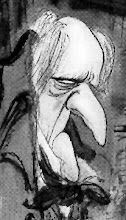
Malcolm's problems with Hague start and finish with two images: the toothy youthful Hague beside Thatcher (left, but only here) and any one of Steve Bell's later grotesques (right, and more accurate).

Trite tripe

The speech, it transpired, was not vintage Hague: too tightly-scripted and designed-by-committee. For, ultimately, Hague is circumscribed in three obvious ways:
  1. He has nothing new to say. UK foreign commitments have not changed significantly these last two months. The postures of the ConDems on matters transmarine differ little from their predecessors. Only yesterday, Liam Fox (the Mod getting its retaliation in first?) nailed the Union Jack firmly above the Kabul last-ditch.
  2. The autumn spending review is the trumpeting Jumbo, still constrained for the time being in the junk-cupboard.
  3. Don't mention the EU. It's all gone swimmingly for the Tories since they acquired the figleaf of coalition, as the continuing suppression of Daniel Hannan testifies. The fractious matter of Europe (the one topic guaranteed to stir trouble inside the party) demands the silence of the "p" in swimming-pool. Hague's single paragraph on the EU was sotto voce between nods to the left for Obama and to the right for Lord Salisbury.
That accepted, Hague was buffing up a decent gloss on the post-Iraqi and extended-Afghani turd.

One sure sign of a minister struggling is a heavy emphasis on the cyberspacial: sure enough, the FCO press-release is headlined: Britain's Foreign Policy in a Networked World.


Much is made about the hundred million young Pakistanis with access to mobile phones, from which they can derive opinions and views. This theme, decorated with a few gratuitous Twitter mentions (see below), suggests Hague needs to reconsider seriously any attempt to cut back on BBC overseas services and, especially, the potent BBC web-sites.


Two details from Hague went straight to the fillings in Malcolm's teeth.

Why decry the amount of trade the UK does with Ireland?

It is estimated that by 2050 emerging economies will be up to 50% larger than those of the current G7, including of course the United Kingdom. Yet the latest figures show we export more to Ireland than we do to India, China and Russia put together.

That is a totally fallacious factoid.

For a start the British and Irish markets are effectively integrated: look at the small print on your cornflakes package or toothpaste tube for evidence. When Malcolm's alter ego pays his annual MobileMe due to Apple, it is surcharged at Irish VAT rates. A large proportion of Irish imports are re-exports via Britain. The good folk of Buncrana are fated by geography to do some shopping in Derry. The Maheraveely motorist, in urgent need of a new tyre, may head for Clones.

What's this about Castlereagh?

For no obvious gain, except a rhetorical flourish, Hague trotted out this:
When Foreign Secretary Castlereagh went to the Congress of Vienna in 1814 it was the first time a British Foreign Secretary had even set foot overseas to meet any of his counterparts since 1782 when the position of Foreign Secretary was established. Today Foreign Ministers communicate through formal notes, highly frequent personal meetings, hours a day on the telephone to discuss and coordinate responses to crises, and quite a lot of us communicate by text message or in the case of the Foreign Minister of Bahrain and I, follow each other avidly on Twitter.
All that shows is an ignorance of the circumstances of the time of George III. It also ignores the scurry of delegates (foreign ministers of stature, if not in name) from London across Europe in those years. Leaving aside the facile notion that the involvement of a nominal Foreign Secretary comprehends the totality of a foreign policy, Hague might have reflected on (say) June, 1520, and The Field of Cloth of Gold. Was that not cutting-edge (if, ultimately ineffectual) foreign relations?

Anyway, consider what Oliver Cromwell's Secretary for Foreign Tongues (one John Milton, no less) might have been able to express, with or without the medium of Twitter. Hague (1 July 2010) will not endure as Long or as memorably as John Milton an Englishman His Defence of the People of England (24 February 1652). Milton's invective is more inventive, more vitriolic and more enjoyable, if nothing else.

Hmm: Milton's publsher there (see right) appreciated the organic link between Britain and its westward island: another lesson that Hague might note (though the Irish excoriators of all things Cromwellian might cavil).

A banal bottom line

After all his frotting and frothing, Hague concluding with a miserable punch-line. Pick the bones out of this, if you can find even one:
So we are now raising our sights for the longer term, looking at the promotion of British interests in the widest sense. In the coming months we will develop a national strategy for advancing our goals in the world that ties together the efforts of government, that is led by foreign policy thinking, that works through strengthened international institutions as well as reinvigorated bilateral relationships, that is consciously focused on securing our economic prosperity for the future, and that unashamedly pursues our enlightened national interest of seeking the best for our own citizens while living up to our responsibilities towards others. In short, it is a foreign policy that embraces the networked world. For seen in this light, although the next twenty years is likely to be a time of increased danger in foreign affairs, it is also a time of extraordinary opportunity for a country that sets out to make the most of the still great advantages the United Kingdom certainly possesses.
Hardly Miltonic. Where Milton present (a solecism which reminds Malcolm of a former Headteacher of Malcolm's acquaintance announcing to the full school assembly that "Beethoven is dead at the moment") he might find a Puritanical chortle as he struggled to decide which motto from Horace's Ars Poetica best summed Hague's spiel:
  • Difficile est proprie communia dicere. [It is hard to speak common truths in a way of one's own.]
  • Brevis esse laboro, obscurus fio. [When I struggle to be brief, I make myself obscure]
  • Parturient montes, nascetur ridiculus mus. [The mountains labour, give birth to no more than a ludicrous mouse.]
Sphere: Related Content

Friday, May 14, 2010

The Pert Young Piece opines:

Regulars will previously have encountered Malcolm's daughter, the Pert Young Piece.

Her reaction to Noto55:
The coalition want 55% and we will have the power to recall corrupt MPs.

Well, surely any MP — Tory or Lib Dem —who votes for 55% is offending democracy and corrupt. So, let's recall them all, the day after the vote.

Sent from my iPhone
Sphere: Related Content

Thursday, May 13, 2010

The 55% rule

For the record, this was Southsea Expat's comment on Iain Dale's Diary:
The requirement for a no confidence motion to bring down the Government will remain 50% +1. The new 55% requirement is for a vote to bring about the dissolution of Parliament — a completely separate thing. It is standard practice in other countries which have fixed term parliaments — to prevent the party in power from getting round the fixed term by voting against itself and thus bringing about an election at an advantageous time of its own choosing. So it is a necessary part of the move to a fixed term parliament. Under the proposed new system the government could lose a confidence vote if 50% +1 voted against them. The Prime Minister would then have to resign and the Queen could invite the leader of another party to form a government. What the Prime Minister could not do would be to use a no confidence vote to trigger a general election. The actual dissolution of Parliament would require a 55% vote. This paper from the Constitution Unit at University College London explains the issue. You will see that the Liberal Democrat Manifesto pledged to
introduce fixed-term parliaments to ensure that the Prime Minister of the day cannot change the date of an election to suit themselves
whilst the Conservative manifesto pledged to make
the Royal Prerogative subject to greater democratic control so that Parliament is properly involved.
Since the Labour manifesto also contained a pledge to bring in fixed term parliaments, I am not sure why any of the parties are getting so upset about this.
All of that is fair; and above board. Except:

The 55% rule

There are (nominally: the following assumes Thirsk & Malton votes Tory) 650 seats. the outcome was:
  • Conservative: 306
  • Labour: 258
  • Lib Dem: 57
  • Democratic Unionist: 8
  • SNP: 6
  • Sinn Féin: 5
  • Plaid Cymru: 3
  • Social Democratic and Labour: 3
  • Alliance: 1
  • Green: 1
  • Independent Unionist: 1
  • The Speaker: 1
Now: 55% of that ConDemLib majority is:
(306 + 57) = 363
Whereas 55% of the Commons is:
357.5
So 358, curiously enough, is about the only round number which would guarantee a ConDem majority against all eventualities. In effect, the ConDem government is reckoning to lose just half-a-dozen by-elections in a five-year parliament. [See below.]

Were there more losses, or a few defections, would the 55% rule be suddenly adjusted upwards?

Bottom line:

There are two different issues here:
  1. does an administration have the confidence of the House of Commons?
  2. does the lack of confidence require the government to renew its mandate by seeking a popular vote?
Until this moment, those have been regarded as inseparable. This coalition seeks to perpetuate itself, for an unconscionable five years, by separating the two.

For a start, five years is above the normal quota: in practice in the UK, by legislation pretty well everywhere else. Four years (as for the devolved Assemblies) might, just might be more reasonable.

Consider that fifth year: a lame-duck parliament. It is in the interest of every non-government party, for sheer electoral reasons, to vote solidly against the administration. "Pairings" and other arrangements would go by the board. Many of those votes will be lost by the administration. In effect, for a year, the government is by that 55% rule.

Any, and every government is, to some extent, a coalition. Some are explicit. Others, even most, are not. This one, against all tradition is trying to impose a rule which suits only itself.

That is the breach of democratic principle involved. Sphere: Related Content
Fair play for Lord North!

The previous post sent Malcolm in search of what brought down Lord North's government. He was vaguely sure that it wasn't a full-blown vote of confidence (and, even if it were, in those days if that would have been terminal).

So here's the key bit from the DNB, written by Peter Thomas (who published the still-current biography in 1976:

The last act of North's ministry was played out on the appropriate stage of the House of Commons, during February and March 1782. Only once, on 27 February, was the ministry defeated, over a motion to end offensive war in America. The vain hope that George III would allow North to negotiate peace kept him from resigning, but he now lost the backing of MPs who had supported his stand against American independence. After his majority fell to nine on 15 March, a group of independent MPs informed him they were withdrawing support, and, facing defeat on the next vote of confidence on 20 March, he thereupon informed the king that he must resign:
The Parliament have altered their sentiments, and as their sentiments whether just or erroneous must ultimately prevail, Your Majesty, having persevered, as long as possible, in what you thought right, can lose no honour if you yield at length, as some of the most renowned and most glorious of your predecessors have done, to the opinions and wishes of the House of Commons. (Correspondence of George III, 5.395)

Only with ungracious reluctance on 20 March itself did George III accept this constitutional lesson, accusing North of desertion. He, by contrast, in his Commons resignation speech that day, behaved with ‘equanimity, suavity and dignity’, diarist Wraxall recalled, thanking the house for its long and steady support, and declaring his readiness to answer for ‘his public conduct’.
On the other hand, North was a rank and unreconstructed aristocratic bastard: both his American and Irish policies were disastrous.

So, let's not take this "fair play" thing too far. Sphere: Related Content
Free the Prime Ministerial Eleven!

Clearly, the Torygraph hasn't relented on its anti-Cameron campaign. The last couple of days brought huge doses of urine from Simon Heffer (not surprisingly) and little enthusiasm from Benedict Brogan. Today, on its blog-pages, Gerald Warner was licensed to bite the legs off Theresa May, the incoming Home Secretary, a.k.a. Commissar for Wimmin and Equality on the grounds that:
May is a one-woman disaster area, a ticking time-bomb of incompetence waiting to detonate in one of the more sensitive departments of state...

May is the archetypal moderniser, the Cameronian revolution’s Goddess of Reason. As shadow Transport Secretary she distinguished herself by failing to lay a glove, over months, on the mortally wounded Stephen Byers. At the Conservative Party’s 2002 conference she coined the ricochet phrase “the nasty party”, which damaged the Tories more than any demonising slogan that Mandy, McBride et al. could devise. At the 2005 conference she strutted the stage with kitten-heeled arrogance and lectured the assembled voluntary workers: “There is no place for you in our (sic) Conservative Party”, as she promoted the kamikaze modernising agenda. That was the first notification the party faithful had that ownership of the party had passed from them to a clique of the Entitled Ones.

As the “nasty party” example demonstrated, May has always possessed an uncanny capacity to damage the Tory Party. In the office of Home Secretary she will now have unrivalled scope to exercise that talent. She occupies the post because Chris Grayling who shadowed it, in a moment of fatal candour, confessed to a modicum of sympathy for B & B owners compelled to allow homosexual activity within their own homes.

That was enough to destroy his career: in the Compassionate Conservative Party the slightest hint of compassion for ordinary, non-metrosexual Britons – still worse, for Christians – is a ticket to oblivion.
Come on, Gerald! You can do better than that!

And, sure enough, he did. On a topic that needs far more attention than Ms May:
... there is the proposal to raise the bar for voting down a failing government on a vote of no-confidence to 55 per cent of MPs. At present, 50 per cent plus one is sufficient. This measure would preserve in power governments that had lost the confidence of a majority in the House of Commons as large as 54 per cent. Since the first vote of no confidence brought down Lord North, on account of certain little local difficulties in the American colonies in 1782, a total of 11 Prime Ministers have been ejected from office in this way.
In other words:
  • Lord North lost the confidence of Parliament along with the American colonies.
  • Jim Callaghan lost the confidence of the Commons because, honourably, he prevented the Whips dragging in the dying MP, Alf Broughton (while Frank Maguire, MP for Fermanagh and South Tyrone, turned up to "abstain in person").
In point of fact, Lord North went before he was pushed. But let's not undermine a good story.

Suddenly now a "majority" of the Commons no longer means (Number of MPs voting)÷2 + 1 (which, in practice means about 310 "nay" votes).

No: it's 55% of (Number of MPs voting) + 1. Which means something like 630 or 631.

ConDems in action. Sphere: Related Content

Wednesday, May 12, 2010

Old slogans revisited

Sphere: Related Content

Monday, April 5, 2010

Malcolm Redfellow learns something new every day ...
Here's another semi-regular which hasn't had a recent outing, so:
Monday, 5th April, 2010: daffodils and falling standards

This day Malcolm's sum of personal knowledge was increased in two small ways.

1. There is such a thing as the "National Daffodil Collection":
A field of yellow at the National Daffodil Collection at Trevarno, Cornwall (left), heralded the onset of spring as much of the country enjoyed Easter Day sunshine.
Alerted by that Tim
es piece, Malcolm went to the fountain-head for clarification:
The National Daffodil Collection Showgarden at Trevarno now features over 2500 varieties and celebrates a joint venture with Ron Scamp, an internationally renowned daffodil grower, Mark Vandervliet of New Generation Daffodils in Cornwall and Carlos Vanderveek from Breezand in Holland. The collection has been extended to include much of Carlos’s own collection and that of the late Karol Vanderveeks famous collection in Holland.

The Collection at Trevarno is now the greatest available for public viewing and research to be found in the world today. As time and space permits more will be added. Surely a display not to be missed!
-- Ron Scamp?
-- No more cheap sniggering, thank you, Malcolm!

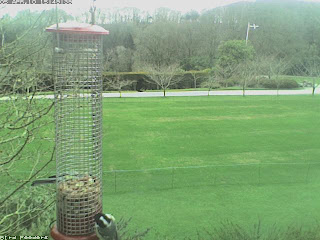
Anyway, Trevorno even has a web-cams (right) so one can watch the Cornish rain falling, the flag of St Piran a-flutter in the background, and the
small birds feeding.

Not a bad bit of serendipity.

2. Denim for brekkers!


Also from the Times (page 13, sidebar) comes more deplorable laxity:
A last bastion of formality has crumbled with news that jeans can now be worn at the Ritz, London's most opulent hotel. However, the rule applies to breakfast only and sticklers for tradition will be reassured to hear that trainers will still not be permitted.
Phew! Malcolm can breathe again.
The old boy's cardiac arrest was imminent for an instant there.
Sphere: Related Content

Friday, March 12, 2010

Malcolm Redfellow learns something new every day ...

Friday, 12th March, 2010: Malcolm makes a Scandinavian connection

Today the BBC web-site has this:
The burial pit (Copyright: Oxford Archaeology)
Archaeologists are trying to link the find to historical events

Weymouth ridgeway skeletons 'Scandinavian Vikings'

Fifty-one decapitated skeletons found in a burial pit in Dorset were those of Scandinavian Vikings, scientists say.

Mystery has surrounded the identity of the group since they were discovered at Ridgeway Hill, near Weymouth, in June.

Analysis of teeth from 10 of the men revealed they had grown up in countries with a colder climate than Britain's.

Archaeologists from Oxford believe the men were probably executed by local Anglo Saxons in front of an audience sometime between AD 910 and AD 1030.

The Anglo Saxons were increasingly falling victim to Viking raids and eventually the country was ruled by a Danish king.

The mass grave is one of the largest examples of executed foreigners buried in one spot.

Now that rings bells.

So Malcolm went back to the Anglo-Saxon Chronicle, which reported local skirmishes with Danish invaders in:
A.D. 837. This year Alderman Wulfherd fought at Hamton with thirty-three pirates, and after great slaughter obtained the victory, but he died the same year. Alderman Ethelhelm also, with the men of Dorsetshire, fought with the Danish army in Portland-isle, and for a good while put them to flight; but in the end the Danes became masters of the field, and slew the alderman.
A.D. 845. This year Alderman Eanwulf, with the men of Somersetshire, and Bishop Ealstan, and Alderman Osric, with the men of Dorsetshire, fought at the mouth of the Parret with the Danish army; and there, after making a great slaughter, obtained the victory.
Both those dates lie outside the predicted period in the story above. Then we have:
A.D. 982. In this year came up in Dorsetshire three ships of the pirates, and plundered in Portland. The same year London was burned.
A.D. 998. This year coasted the army back eastward into the mouth of the Frome, and went up everywhere, as widely as they would, into Dorsetshire. Often was an army collected against them; but, as soon as they were about to come together, then were they ever through something or other put to flight, and their enemies always in the end had the victory. Another time they lay in the Isle of Wight, and fed themselves meanwhile from Hampshire and Sussex.
and finally:
A.D. 1015. This year was the great council at Oxford; whereAlderman Edric betrayed Sigferth and Morcar, the eldest thanes belonging to the Seven Towns... At the same time came King Knute to Sandwich, and went soon all about Kent into Wessex, until he came to the mouth of the Frome; and then plundered in Dorset, and in Wiltshire, and in Somerset. King Ethelred, meanwhile, lay sick at Corsham...
Pick the bones out of that lot.

Sing a song of ...

At some point in there, we had the origin of London Bridge in falling down ...

Then another link came to Malcolm's mind.

When it came out in about 1972, Malcolm acquired a copy of Karl Dallas's book of folk songs, The Cruel War [out of print: ISBN-13: 9780723404934; ISBN: 0723404933]. It's still there on Malcolm's shelves, and (like so much of his library) he wouldn't part from it this side of the crematorium.

The Cruel War includes a song Ruth Tongue, in her The Chime Child [out-of-print SBN: 0710029675/ ISBN-13: 9780710029676], claimed to have collected in 1918:
I had just finished a Folk Song Recital in London, and made my way back to sink exhausted into my dressing-room chair, when there came a hearty bang on my door which opened, and an elderly sea captain came in. He was smart, grey-haired, scarlet-faced, and as full of enthusiasm as a young westerly gale -- and he had a ballad for me. His family had been Porlock folk right back to Drake's time and before, and they had treasured and kept strictly to themselves this ancient ballad. Now having listened to that evening's Somerset wealth, he had decided regardless of family traditions that it must be brought to the free air of a singing world and that I was the one to do it. Before the force of this Severn Gale, I found my weariness blown clean away, and was soon singing too. He had a tremendous voice and it hit like hammer-blows into my memory. He sailed tomorrow he said, so I must learn it then and now. I did, every verse, and sang it back to him. He gave me a delighted smile, a hearty farewell and a handshake that clamped my fingers for the rest of the evening, and went away, forgetting to leave his name.
There are all kinds of suspicions about Ms Tongue's "accuracy", and her anecdote here seems as bit ... fishy.

However, hers is a good story. The ballad is Three Danish Galleys:
Three galleys come sailing to Porlock Side,
And stole me away a new-wed bride,
Who left my true love lying dead on the shore,
Sailing out and away.
I never shall see my dear home no more.
What makes that even more curious is a reference, again from the Anglo-Saxon Chronicle:
A.D. 918. This year came a great naval armament over hither south from the [Breton-based pirates]; and two earls with it, Ohter and Rhoald. They went then west about, till they entered the mouth of the Severn; and plundered in North-Wales everywhere by the sea, where it then suited them; ... but the men of Hertford met them, and of Gloucester, and of the nighest towns; and fought with them, and put them to flight; and they slew the Earl Rhoald, and the brother of Ohter the other earl, and many of the army. And they drove them into a park; and beset them there without, until they gave them hostages, that they would depart from the realm of King Edward. And the king had contrived that a guard should be set against them on the south side of Severnmouth; west from Wales, eastward to the mouth of the Avon; so that they durst nowhere seek that land on that side. Nevertheless, they eluded them at night, by stealing up twice; at one time to the east of Watchet, and at another time at Porlock. There was a great slaughter each time; so that few of them came away, except those only who swam out to the ships...
These things come back to haunt us. Sphere: Related Content

Saturday, March 6, 2010

Malcolm Redfellow learns something new every day ...

Sunday, 7th March, 2010: military intelligence

It is a well-known truism that the British War Office was always prepared to fight the last war. That needs a whit of modern updating, "... and the next spending review".

There are certainly quite a few retired brass-hats now able to assure the world that the military deficiencies shown up in the Irag campaign were all the fault of the Treasury.

It all goes with perfect 20/20 after-vision.
____________________

Now Malcolm is still recovering from the long effort of striving for the end of James Ellroy's Blood's a Rover. Perhaps labour worthy of a better cause. The effort was a month in the achieving, with delightful intermissions such as
  • Jasper fforde's Shades of Grey [get it in hard back for £8.49, rather than wait for the paperback at £7.99 in the late autumn], which owes something to Brave New World, to John Christopher's The Guardians, and to all those other dystopias;
and
  • Malcolm Pryce's From Aberystwyth With Love, the latest of his Louie Knight stories, in which West Wales becomes a hardboiled parallel universe.
So, what next?

Well, here by the bed is an unread, mint copy (Oxfam books at £4.99, and still over-priced) of The War Within, the fourth of Bob Woodward's investigative-journalist contemporary-histories of the Bush Administration.

That is where Malcolm found his insight for this "something new everyday". Here is Woodward's account of Colin Powell before the blue-ribbon Congressional Iraq Study Group:
Perhaps more than anyone in the administration, Powell had been the "closer" for the president's case for war. A month before the war, he appeared before the United Nations and the world to make the public case, displaying what he said were the "facts" proving that Iraq had threatening stockpiles of weapons of mass destruction (WMD). The 76-minute presentation had proven effective, too effective, with Powell displaying all his powers of persuasion.

Four years later, no WMD had been found, many saw the war as a catastrophe, and Powell's reputation was irretrievably linked to it, forever damaged. So the 10:30 A.M. meeting on this Friday was both a mission of accommodation and penance. He was going to have to confront the war and its aftermath for the rest of his life, and this was but another stop on the road to sort out his anguish.

As he entered the small conference room, Powell was greeted warmly by the members of the group. He gazed around the room. There must have been a jailbreak, he joked. The room erupted in laughter.

There was an obvious camaraderie between Powell and the group members, most of whom had dedicated much of their lives to building up American power and credibility, winning the last phase of the Cold War and shaping a world in which the United States was the only superpower. Now Iraq threatened to undermine all they had built.

[President GHW Bush's Secretary of State, James A.] Baker and [Chair of the House Committee on Foreign Affairs, Lee] Hamilton sat together at the head of a table, with Powell directly across from them. The other members lined the sides of the table, and staff sat along the wall.

Did Powell have something to say up front? Baker asked.

"I have no opening statement."

Okay, then why did we go into Iraq with so few troops? Baker asked.

It was an unusual starting point. The study group was supposed to focus on future remedies, not past troubles. But the question of troop levels seemed to be at the heart of the problem, and the relatively small invasion force of some 150,000 troops had contradicted Powell’s philosophy of warfare—namely to send a large, decisive force that would guarantee success. For the 1991 Gulf War—a far simpler military task of ejecting the Iraqi army from its occupation of Kuwait—Powell, then JCS chairman, had insisted on a force of 500,000.

Baker’s question sparked a monologue that went on for nearly 20 minutes.

"Colin just exploded at that point," Perry recalled later.

"He unloaded," [Bill Clinton's Chief of Staff] Leon Panetta added. "He was angry. He was mad as hell."

Powell cited pages 393 to 395 from American Soldier, the memoir of General Tommy Franks, who was in charge of Central Command at the time of the Iraq invasion. Quoting from memory, he noted that Franks had faithfully reported a call that Powell had made on September 5, 2002, six months before the invasion. "I've got problems with force size and support of that force, given the long lines of communications" and supplies, Powell had warned Franks.

"Colin Powell was the free world's leading diplomat. But he no longer wore Army green," Franks had written. "He'd earned his right to an opinion, but had relinquished responsibility for the conduct of military operations when he retired as the Chairman of the Joint Chiefs of Staff in 1993.

"I picked up the Red Switch and spoke to Don Rumsfeld. 'I appreciate his call,' I said. 'But I wanted to tell him that the military has changed since he left.'"

Franks reported that "Rumsfeld chuckled," but wanted to make sure that Powell's doubts were aired. "I want him to get them on the table in front of the president and the NSC. Otherwise, we'll look like we're steamrolling," Franks quoted Rumsfeld as saying.

Again citing Franks's memoir, Powell noted that he had raised his concerns at an NSC meeting held at Camp David with the president two days later. According to Franks's account, "Soft-spoken and polite, ever the diplomat, he questioned the friendly-to-enemy force ratios, and made the point rather forcefully that the Coalition would have 'extremely long' supply lines."

Powell did not mention that two pages later, Franks wrote that he had outlined his war plan without objection. "Colin Powell didn't debate the brief I gave, and he didn't ask any more operational questions," Franks wrote, suggesting that Powell did not persist.

Powell acknowledged to the study group that he couldn't have predicted the insurgency or the chaos of post-invasion Iraq. But he did know that such a mission required plenty of troops. It was the Powell Doctrine: Go-in big. Go in to win.

Seven months before the war, Powell had asked for a private meeting with President Bush to layout what he felt were the consequences of an invasion of Iraq that the president and his team had failed to examine. Powell and his deputy, Richard Armitage, summed it up this way: "If you break it, you own it."

At the study group meeting, Panetta later recalled, Powell said he had warned the president. "I did make clear that once this happens, you're the one who is going to have to pick up the pieces and put it back together again. And it's not going to be easy to do." Or as he put it later: "We not only did not have enough troops to stabilize the country and act like an occupying force, we didn't want to act like an occupying force. But we were the occupying force. We were the government."

In the classic sense, Powell told the group, there had never been a "front" to this war. The insurgency had begun from behind.

After his recapitulation on force levels, Powell moved without pause to the lack of postwar planning. He said he was stunned that Rumsfeld, when asked publicly about rampant looting in Iraq, had said, "Stuff happens." At a Pentagon press conference three weeks after the invasion, Rumsfeld had said that freedom was "untidy" and the extensive looting was the result of "pent-up feelings" from decades of Saddam Hussein's oppression. Powell quoted the defense secretary's "stuff happens" with utter disdain, suggesting it was an absurd evaluation and an abdication of responsibility.

Throughout that spring of 2003, Powell said, he'd kept thinking to himself, "When are we going to get this together?" All the Pentagon would say was, "Chalabi is coming, Chalabi is coming," a reference to Ahmed Chalabi, the Iraqi exile with a checkered past who had long opposed Saddam Hussein. Chalabi had been the poster boy for a new democracy in Iraq, but Powell was dismissive.

"It was just Chalabi and 600 thugs," Powell said, noting that Chalabi failed to live up to the promise he'd made to the Pentagon to show up in Iraq with 10,000 men.

As secretary of state at the time of the invasion in 2003, Powell said he wasn't told about the decision to dissolve the Iraqi army until it happened. It was a monumental decision that disbanded the entire Iraqi army with the stroke of a pen, and its enactment was contrary to previous briefings that had been given to the president and to Powell. Nor was Powell told in advance about the sweeping de-Baathification order banning members of Saddam's Baath Party from many levels of government. It had effectively pulled the rug out from under the bureaucracy that made the country run, as many Iraqis had needed to be Baathists simply to get a job within Saddam's government.

Powell expressed astonishment that officials who lacked proper credentials had been sent to Iraq. He specifically mentioned Bernard Kerik, the troubled former New York City police commissioner, whom Bush had named to head the Iraqi national police and intelligence agency. "Bernie Kerik is in charge of police?" Powell asked, with a mixture of mock surprise and disgust. "Where did Bernie Kerik come from?"

Though he had been out of government for a year and a half, Powell's anger seemed fresh and raw. And now it had risen to the surface for them to see as he channeled years of accumulated resentments into his testimony.
Now, Malcolm reckons that teaches us a great deal:
  • Powell's Go-in big. Go in to win is conventional orthodoxy. It has been shown to be the most dependable strategy for most of military history and was Eisenhower's in North Africa and Normandy. One can assume it is the most basic rule taught at West Point. Yet, for the Iraq campaign and its lamentable aftermath, up to Bush's last-throw "surge", it was discounted.
  • If the supply lines were "extremely long" for the US logistical potential, they must be even more difficult for British forces, operating well out of their usual theatres. Did any UK military figure point this out to his political masters?
  • Not all the responsibility can be dumped on the Bush cronies. As Woodward comments (in connection with General George Casey being appointed to take over the Iraq command in May 2004):
The general attitude in the US military was "We can do this. Get out of our way. We'll take care of it. You guys stand over there."

This did not sell itself to Donald Rumsfeld. With such disconnection between the Pentagon and the Washington politicians, then, again, the British were further back in the queue.
  • If Powell, Secretary of State, was regularly by-passed on major decisions, we can reasonably assume that the British were equally kept out-of-the-loop. The whole of Woodward's book makes this clear by omission: Tony Blair achieves a single mention (pages 224-5): even Lawrence of Arabia gets two.
Throughout the book Woodward keeps coming back to what Powell says there, which is later defined as "the Pottery Barn rule": you break it, you own it. Deficiencies in US strategy, implementation and planning smashed the shop in Iraq (and, arguably, continue to do so in Aghanistan). Yet the opposition parties in Britain, and some political brass hats, seek to place the ownership of the breakages entirely on Blair and, now, Brown.

Surely something wrong?

Sphere: Related Content

Thursday, March 4, 2010

Malcolm Redfellow learns something new every day ...

Thursday, 4th March, 2010: The Word of God is Copyright

It was published in 1611, and four centuries on is still copyrighted.

A letter in the current issue of The Times Literary Supplement:
Bible copyright

Sir, -There has been some discussion recently in the TLS about copyright and the internet. On March 3, Cinnamon Press published my novel Livingstone's Funeral. In an early section, set c1880, an Anglican missionary to southern Africa is challenged by chiefs to prove the power of the new religion by making rain. He responds with a service which features a reading from 1 Kings 18, describing the confrontation between Elijah and the prophets of Baal. The passage is quoted from the Authorized Version.

It turns out to be very expensive to quote from the AV, in which the royal family holds a perpetual copyright. The Authorized Version was (in Joan Bridgman's words) "mostly cribbed" from William Tyndale's Bible of 1537. Tyndale was burnt at the stake for putting the Bible into the hands of any Englishmen who could read. An act of royal plagiarism, followed by an act of perpetual copyright. Is this what is meant by the title "Defender of the Faith"?

A minor consequence is that my novel is forced into anachronism, as my publishers use an alternative translation. Meanwhile, there are currently 300,000 internet sites from which the Authorized Version may be downloaded.

LANDEG WHITE
Quinta Terra da Vela, rua do Rigueirinho 19, Carapinheira, 2640-308 Mafra, Portugal.
Sphere: Related Content

Thursday, January 28, 2010

Thursday, January 14, 2010

Plus ça change, plus c’est la même chose

In a different context, Malcolm was considering the contribution of the historian E.H.Lecky (1838-1903). For anyone with a TCD background, that's familiar territory: a seated statue, a library and a professor of history with his name.

Scanning the Dictionary of National Biography entry about Lecky, Malcolm hit on this:
He saw Gladstone as an honest man with a dishonest mind who, by skilful casuistry, could persuade himself that he was in the right, and then, his moral nature taking fire, act as if under a divine impulse.
That seemed uncannily descriptive of a much later, quite recent, occupant of 10 Downing Street. Sphere: Related Content
The speed of sound

1. The smallest unit of measurable time:
that between the traffic-light turning green and the boy-racer behind hooting.
2. The shortest telephone call on record:
"Congratulations! You have been selected ..."
Sphere: Related Content

Wednesday, January 13, 2010

Then it was Richard II: this time it's Tesco

We've been this way before, too often, and quite recently, with quick-off-the-mark lawyers attacking parliamentary privilege.

Today John Hemming (Lib Dem MP for Birmingham, Yardley) reported a threatening letter from a firm of solicitors. The Speaker has agreed to debate the thing tomorrow.

Tesco intend to build a supermarket in Hemming's patch: this is substantially expanding the "Swan Centre" on Coventry Road in Yardley. To this end, Tesco bought land off Sainsbury's and Asda. So, no hint of a cartel this far.

It is not, locally, a resoundingly popular development, in part because it involves the construction of a huge carpark and a race-track. So protestors tried to buy up enough land to block the project.

The local authority, who have a vested interest in so far as it would inflate the rates income, and probably suck up a bit of local unemployment, has gone for the Big Stick: a compulsory purchase order.

Somehow Tesco thinks Hemming has overstepped a line in the sand. The retail giant has employed Withers, solicitors, to do the deed. Withers sent an email. Hemming, not unreasonably, feels he is being crowded.

He complained to the Speaker.

For the record "parliamentary privilege" began in 1397. Sir Thomas Haxey dared to query King Richard II's household budget. Haxey was deprived of his title and his property. When Richard had been deposed, the new king, Henry IV, had Parliament reverse the sentence, because it ran against the law and custom which had been before in Parliament.

These Lib Dems, doing what is right and proper, really annoy Malcolm when he has to agree with them.

More:

The Economist update, dated yesterday:
Political rights and civil liberties around the world suffered for the fourth year on the trot in 2009, according to the latest report published by Freedom House, an American think-tank. This represents the longest continuous period of deterioration in the history of the report. The number of electoral democracies dropped from 119 to 116, the lowest figure since 1995.

Sphere: Related Content

Monday, January 11, 2010

Not a celebrity, but get me out of here!

Two closely-related topics revisited over the Christmas dining table were
  • which daughter, son-in-law and brood would be daft enough to want to occupy Redfellow Hovel over the 2012 Olympic period?
  • what place of refuge, well away from Redfellow Hovel and North London, might shelter the Lady in his Life and Malcolm?
Chez Redfellow is totally tolerant of numerous perversions between consenting adults, so there is no active resentment of things athletic and sporting. It's just the endless boosting, ballyhoo and the bounty of billions.

All of which was reinforced by Carl Hiaasen's weekend piece for the Miami Herald.

The [American] National Football league are taking the hump over the facilities at Miami Dolphins stadium, where the annual Super Bowl is regularly held. The NFL are threatening to take their business elsewhere if the stadium is not upgraded to their requirements:
at a cost of $250 million, give or take.
Hiaasen is not convinced:
It's old-fashioned extortion, but the NFL has no shame. You'd have better luck negotiating with the Gambino family.

Forget the recession. Forget the fact that our boneheaded politicians just committed $490 million to a new baseball park that is doomed to be a budgetary suckhole for decades.

And forget the fact that the football stadium was renovated just a few years ago for $200 million-plus, and that the Dolphins admit they don't need any upgrades for regular-season games.
Remember: this is Hiaasen. We're in safe hands. It inevitably gets better:
Virtually every independent economic study, including one by the Florida Senate in 2005, has shown that publicly funded sports stadiums are a rotten deal for taxpayers.

Philip Porter, an economics professor at the University of South Florida in Tampa, said that having an occasional Super Bowl in a major winter tourist destination such as Miami amounts to basically a hiccup.

"If you wanted economic impact,'' he told The Herald, "you'd do a lot better taking the money you would spend on a stadium and drop it out of a helicopter.''
The punchline comes from much, much nearer home, close to where (literally and metaphorically) Malcolm lives:
... based on recent history, there's good reason to worry that local leaders will surrender to the NFL's clumsy arm-twisting. If that happens, they deserve an angry flogging by fed-up voters.

Any officeholder who feels inclined to waste tax dollars on another stadium makeover should take a cue from The Who, the iconic rock band that will perform at this year's Super Bowl halftime.

Don't get fooled again
Err, yes. If those helicopters currently sowing the seeds of urban renewal over east London happen to lose direction, and shower Muswell Hill with green fertility, things might seem different. Meanwhile, there's always some consolation:

Sphere: Related Content

Wednesday, January 6, 2010

Comms failure?

For much of the day, the BBC has been running an apology for a breakdown in feed.

Did Malcolm miss it, or was the usual PMQ feed gone AWOL?

Is this at all related to the story that Private Eye has been serialising about the "Digital Media Initiative" out-sourced to Siemens ? That involved the Beeb coughing £2 billion over ten years for Siemens to take over BBC Technology. MPs soon discovered that 60% of the new operations were delayed or went significantly over budget. There then were discrepancies in the reporting of the alleged "savings". The BBC DG had to generate a new oversight board, chaired by himself: in effect recovering the thing back in-house.

Those of us who have just coughed our annual licence fee need to be told. Sphere: Related Content

Tuesday, January 5, 2010

The Major has a problem

Saturday, 2nd January, 2010, Middlyng Grange:

Major Sir Arthur Muddlyng-Threw sat on the gun-room settle, cleaning his grandfather's, the fourteenth baronet's, old Purdy.

Sir Arthur had been out at dawn with "young" Mellors (now only a bit shy of retirement age), his nephew's game-keeper, for a bit of rough pigeon-shooting.

In the old days, Sir Arthur would have been a regular at the Earl's shoots: that's how it worked when Arthur, not yet inherited, came back from military service; and set about courting the old Earl's youngest daughter. Nowadays, though, the Estate was run on business lines: the pheasants were reserved for paying customers. With luck, aided by the once-yearly guns failing to deplete the coverts, Sir Arthur would have an invitation to stand in the end of the season shoot.

Sir Arthur had a soft spot for Mellors: as a schoolboy he had been inducted into the mysteries of poaching by "old Mellors". Eventually, the Earl had tired of handing Mellors down fifteen-shilling fines, with costs. Then there were the seigneurial obligations: Mellors had served in the County regiment and had a decent war. So the Old Earl recruited "young Mellors" as an under-keeper. That was how old-fashioned country wit and wisdom worked. The Estate gained a fine and expert recruit: the Earl added insurance for his own preserves, for the father could not endanger the son's new livelihood. If the pheasants on the neighbouring estates went missing, that was hardly the Earl's problem.

Double-locking the Purdy away, Sir Arthur reckoned some similar ruse might now be required of himself.

New Year's Eve, 2009

Closing his books for the year, Sir Arthur, had one of those difficult mornings with Moneypenny, his accountant. It wasn't that the Muddlyng-Threws were on the rocks: Moneypenny had more tricks than a circus pony. The sale of that third-rate Stubbs at the height of the market had been a coup. Those damned oil shares went up-and-down like a doxy's unmentionables .... Down, boy! laughed the Major's younger conscience. As if, sneered the reality of the elder rival lobe of reality.

The problem, then, lay elsewhere.

Moneypenny had another role, committee-man of the Loamshire North Conservative Association, of which the Major was hereditary and perpetual life president. By several allusions, circumlocutions and hesitations, Moneypenny had implied that a presidential visit to the Association might be in order.

Saturday, 2nd January, 2010: Loamshire North Constitutional Club
"How wonderful to see you, Sir Arthur!"
The Major had telephoned through to arrange lunch: it would be no more than a cold buffet, but quite adequate. He wasn't here for the food.

He spent an hour in the bar:
"Just a pint of Riproarer, if you'd be so kind."
His GP was insistent that was his daily ration, before switching to burgundy (which was not on the banned list). The Major didn't need to circulate: one by one the officers, evidently warned that the Old Man was attending, came and paid court to him. What transpired was not a happy story.

The Member was conspicuously a non-attender. There was nothing unusual about that. Apart from required appearances, and a fortnightly surgery, he was generally an absentee, preferring to spend his time with ... someone ... on the Dorset coast. The someone had been a previous problem, particularly when a pressman started asking. The Major felt the Association had skated over that one quite nicely: the Whips dispatched the Member on a series of overseas jollies; the wife had taken a cruise; a divorce went through quietly. None of that messy business they'd had in Bedfordshire.

Then there were the blasted bird-baths. The Member ...
"That Bloody Fool!"
... had been gilding the lily, the lily presumably being the someone, through a series of extras added on his Commons mess account. The alabaster bird-baths illustrated column one, front page of the Telegraph (though fortunately the link to the someone wasn't made).

It had been generally agreed that things could not continue: the Member's license had cancelled his licence. He had to go.

The Member had havered. His retirement had been assumed as early as last October. Pressure was brought to bear through November. Tempers were short by December. It was confidently expected that, finally, in the quiet of the Christmas period, a formal announcement could be slipped out.

Now the roof had fallen in.

The Member had taken revenge. By delaying this long, the Association had been effectively disfranchised. London could now impose a short-list of three.

So the choice would be three Central Office clones, three metropolitan suits parachuted in. A media personality or a mucky novelist, a yes-man, somebody's bag-carrier ... It could even be an all-woman short-list. The Grimeborough suburbs would have to be convinced. The countryside assuaged. The Association had to be enthused to work for an outsider.
"And let's not mention that "Turnip Taliban" thing!" confided the Vice-Chairwomen, patting the Major's hand.
The Major sighed deeply. His trigger finger itched: shooting
was too good for the fellow.

Loamshire North Conservatives would not have an easy election.
Sphere: Related Content

Sunday, January 3, 2010

Headline story, The Observer, 3 January 2010:
David Cameron to pledge NHS cash boost for most deprived areas

David Cameron will attempt to shed the Tories' image as the party of the rich and privileged tomorrow by pledging to divert billions of pounds to healthcare in the most deprived areas of the country.

The promise to direct a higher share of NHS resources to boost health in run-down areas was described last night by a senior party source as proof that Gordon Brown's "class war" attacks on the Conservatives were baseless.

1.
Muddlyng Beacon, January 2011:

Major Sir Arthur Muddlyng-Threw, septuagenarian sixteenth baronet, perched himself on the pedestal of the obelisk to the memory of the thirteenth baronet, killed somewhere up the Khyber Pass. He looked down Loamshire Vale, taking in the familiar view. Maggie, his old Labrador, farted once, squatted to cast an eye upward at the Master. With luck they could be here for some time.

Out of the antique Barbour jacket, the Major extracted a forbidden brier pipe, found the shag tobacco kept secreted in the other pocket, and stoked up. Maggie was now quite confident there would be a long, reflective pause, and settled down to snooze.

A year of mixed blessings, the Major ruminated. As perpetual President of the Loamshire North Conservative Association, he felt the election had gone as well as could be expected. Nationally the Party had squeaked a small, fragile, inadequate majority. Locally, the new fellow had not impressed, and the natural majority had been cut significantly. Moreover, the present Parliament would not long survive.

The Major hadn't really taken to the previous man either: then the silly arse had disqualified himself by putting a couple of alabaster bird-baths on his Commons bar bill. This new 'un had been wished on the Association at the last minute, seemed obsessed with meaningless acronyms and initials, and constantly getting his name in the popular prints over this European nonsense. In the Major's acute judgement the Member should be concerned more with his local patch: twice strong words had passed between the Major and the Chairwoman of the Association, to little effect.

For his part, the Major could take or leave Europeans. The French were insufferable, of course. Who really bothered with Greeks, Eye-ties, and Irish? Then there were the Maltese, Cypriots and these strange slavs and other new-minted statelets ... what account were they? On the other hand, though, the Major didn't mind the Huns: he'd seen quite a bit of them as a young Captain posted to BAOR. Good with machines. Fine shots. Sound on things that really mattered.

Ho, hum, he saw even more of that little blonde typist-translator, Silli from Celle, who had so delightfully educated him in conversational German, and other more carnal matters. With that warm memory, for a few seconds the Major's gloom lifted.

Then his heavy harrumph briefly stirred Maggie. With one eye she noticed that the Master's grimness had returned.

It had been a tough Christmas, reflected the Major.

Just as he was half-way through his treasured, last-but-two, bottle of 1977 Graham, all hell had broken loose.

2.

The drawing room of Middlyng Grange. Late afternoon, 25th December 2010.

His youngest grand-daughter, Caroline (but, insistently, "Caro") had turned up at the Grange with her latest chap: a decent cove, with more degrees and handles than were strictly decent. Part of the problem was there already: "Caro" had never been satisfied by horses, skiing and flower-arranging (activities good enough for her mother). Instead she had upped and offed to a University, and qualified herself in some -ology or other. She even authored books on the topic. Worse still, "Caro" had gone quite pinko.

As the glass of port weighed gently in the Major's hand, as he admired the silkiness of the vintage, savoured the faintest hint of aroma, "Caro" dropped the bomb-shell.
"I'm putting up at the next Election."
"Which division?"
"Here, of course!"
At that, the Major's glass of port had come close to spilling.
"But we've got What's-his-name, the new feller! I know he's not our sort, and doolally; but there's no way the Association could kick him out!"
"I'm putting up for the Liberal Democrats."
Therewith a sizable slurp of the prized vintage port went AWOL to despoil the Major's waistcoat.
"What! Why? For heaven's sake!"
"Granny says she'll support me."
In that second, the coronary seemed very close: the putative seventeenth baronet (currently trying to win his second wife's alimony at a poker table in New Jersey) almost discovered the death duties would be light because so would be the inheritance. Baronet called to his Lady:
"Pina!"
3.
Later that day:

The Major had never won a "discussion" with the Lady. This time had been no exception.

Lady Agrippina had forcefully explained to her husband the facts of the matter.

She was patron of the local hospital: they even named a ward after her. She owed them loyalty. The Government were intending to down-grade the facilities, transferring resources, staff and funding to Grimeborough General. This was part of the Prime Minister redeeming that casual pledge "to divert billions of pounds to healthcare in the most deprived areas of the country".

"Caro" and her young man had spelled out the whys and wherefores. It would inevitably be a local issue at the next Election, now believed to be just months away.

4.
Muddlyng Beacon, January 2011:

The Major completed his recce of the situation with his second pipe.

North Loamshire had been Tory since the ninth baronet lost his pocket borough at the Reform Act. Or, by another calculation, since the first baronet led his pikes to Naseby Field. Now a further bit of tradition, a last finger-nail on "power" was being wrenched away.

And yet ... Caro Threw MP (Lib Dem) had a ring to it. In a way it renewed the tradition.

Who to blame?

Well, the times and their changes perhaps.

Or that mean little callow-youth running the Treasury.
"That's the core of the matter", decided the Major. "Never trust a wallpaper-hanger. Look at the trouble we had with that Schicklgruber.
"Come on, Maggie, you silly bitch. Let's go home."

Sphere: Related Content
Subscribe with Bloglines International Affairs Blogs - BlogCatalog Blog Directory
 
Add to Technorati Favorites