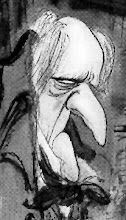
Who he? Malcolm hears you wonder.
Well, Malcolm was not going to start here. He intended to deal with Ms Eliza Gilbert.
Who she? Malcolm hears you wonder.
For that you needs wait for number 18 in this occasional series. Coming up.
The Olivers

In Blarney House hangs a portrait of Captain Robert Oliver (right). In 1649 he had been in Cromwell's army in Ireland. What he took, he kept.
In the County Limerick, take R512 south out of Kilmallock. After seven miles or so, with Seefin Mountain to the west, you pass through the small town of Castleoliver. There is no coincidence in the name. Oliver's first grant was all the land he could see from Seefin: that amounted to nigh on 2,000 acres, extending into the County Kerry. With a bit of manipulation, Oliver increased his holding to over 20,000 acres.
With the land came the need for respectability and a dynastic home.
By 1661 Oliver was MP for the County Limerick: the family would occupy that seat for 107 of the 140 years up to the Act of Union. He built himself Clonodfo
 y House (from Cloch an Otbhaidhigh, also rendered as Cloghanodfoy) nearby. In 1810, his descendant, Richard Oliver, inherited (by marriage) the Yorkshire estates and collieries of Sir Thomas Gascoigne. Clonodfoy was abandoned.
The Gascoigne Olivers later built themselves a new Castle Oliver, which still stands, (left). This grandiose Scottish baronial pleasure-dome has 41 bedrooms and the largest wine-cellar -- 50,000 bottles capacity -- in Ireland) . The architect was George Fowler Jones of York.
To satisfy the burgeoning ranks of genealogy freaks, the line of succession was:
- The Cromwellian Captain and later MP, Robert Oliver, originally of Kent, married Bridget Ormsby, daughter of Andrew Ormsby of Partney. The Ormsbys were Lincolnshire gentry: a branch of the family did well out of the Elizabethan campaigns and occupations in Ireland. In the Earl of Orrery's State Papers we find letters from Richard and Bridget Oliver. In February 1665, it seems that Bridget had come into knowledge of a Puritan plot to restore a “a sober and painful ministry”. So Orrery was able to report back to London that Robert Oliver was "a stout and honest man”. Thus the Oliver estate was secured by the 1666 Act of Settlement.

- Their child was Charles Oliver (right) of Cloghanodfoy, who was Sheriff of Limerick and died in April 1706. In 1670 he married Elizabeth, the daughter of Sir Percy Smyth of Ballynatra.
- Next in line, child of Charles and Elizabeth, was Colonel Robert Oliver of Cloghanodfoy (b c1671, d 1738) who was another of the family's Members of Parliament. Robert Oliver married twice: his first wife in 1702 was Katherine Southwell, daughter of Sir Robert Southwell, the Principal Secretary for Ireland. A second wife was Susanna Knight. One of these marriages, nobody seems sure which, produced:
- Robert Oliver, another of the hereditary MPs, who died in 1745. He married a Jane Silver, daughter of (no! not that one!) John Silver.
- Their son was Silver Oliver, MP, who married Isabella Sarah Newman of Newbury, County Cork, in 1759; and ...
- So we are back to Charles Silver Oliver, born 1763, educated at Eton, served in the 4th Horse and the 7th Dragoons. He married Maria Elizabeth, daughter of Abraham Morris of Dunkettle, County Cork. They produced four sons and three daughters (but -- be warned -- watch this space. Our lad was a goer). He was Sheriff of Limerick in 1791-2. He duly appointed himself Commander of the Kilfinane yeomanry between 1796 and 1807.

The legal murder of Patrick Wallis
Nerves were on edge in The Year of the French, 1798.
One March Sunday morning Oliver's yeoman posse went to hunt down the local United Irishman organiser. Wallis was a tenant-farmer, and 65 years of age. Warned of the raid, Wallis lit out for the hills.
The pursuers became, literally, bogged down: one, Michael Walsh, nearly drowned in the Red Bog. Eventually, Wallis was brought to bay and arrested by Roger Sheehy. The prisoner was incarcerated at Kilfinane.
When Wallis would not name others in United Irishmen group he was whipped at the tail of a cart through Kilfinane. When he still remained silent, he was treated to the same punishment through the cattle-fair of Ballinvreena. Returned to Kilfinane, Wallis was sentenced and hanged.
Charles Silver Oliver ordered his corpse be decapitated, and the head displayed on a stake above the market square of Kilfinane. So the dead man became a local legend as "Staker" Wallis.
That was not the end of the story of Patrick Wallis
The Freeman's Journal, 3rd April, 1800:
LIMERICK, MARCH 29Nor yet the end
On Thursday night last, a number of rebels murdered two men of the name of Sheedy, father and son, near Kilfinan, in this county; they broke open the house, and shot the old man instantly, but the son contrived to get out; they pursued and overtook him, on which the murderers told him that he ran very well after Staker, (a rebel who the young man apprehended, and was executed two years ago at Castle Oliver) but he must now run a different course, on which they put an end to his existence. The unfortunate victims were remarkable for loyalty; the son, a very fine lad, and a member of Captain Oliver's corps of yeomanry.
To mark the bicentenary of "Staker" Wallis's execution and beheading, a memorial was put up in Kilfinane High Street. It consists of a stone head.
The remains of Charles Silver Oliver
Oliver sat in the last Irish House of Commons as MP for the family's rotten borough of Kilmallock. He was thereby complicit in the Act of Union.
His father, Silver Oliver, had represented County Limerick in two Westminster Parliaments. When the father died (in 1799) Oliver was possessed of the 20,000 acres and sought the reversion of the parliamentary seat. Because of gaining the interest of Lord Clare, Charles Silver Oliver elbowed aside his own brother-in-law, John Waller (and there's a family-name worth the study), to take the seat in 1802.
Pitt's ministry considered Oliver a supporter, but not a reliable one. Oliver voted with the Opposition (4 March 1803) to investigate the Prince Regent's expenses, which Dublin Castle noted "was not like a respectable country member". Apart from that he was a persistent absentee, failing to reply to what, in modern parliaments, would be seen as "whips".
After one Parliament Oliver left the Commons. He died in October 1817.
Even then, as the next instalment will show, we are not quite finished with Charles Silver Oliver.
Sphere: Related Content