A nasty intro
We've not ventured into the teccy stuff — and my shelves groan with each addition, most recently the collected works of Mick Herron (and he's bound to get a mention somewhere down the line).
But I was considering openings for novels in that previous post. Which allows me to present you with the most gross. If this doesn't offend, nothing can.
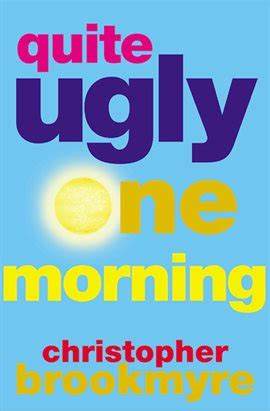
9. Christopher Brookmyre: Quite Ugly One Morning
The entire 'Tartan Noir' thing has to be one of the most remarkable outbreaks of the last few decades in British fiction. It often gets traced back to Val McDermid, who has been knocking them out since the end of the 1970s. In her train came a whole blether of younger ones: none more successful or celebrated than Ian Rankin. Perhaps there's something adrift with the water of the Kingdom of Fife.
Ummm ... I seem to remember, a bit further back, J.I.M. Stewart (a.k.a. 'Michael Innes') who was chilling the blood pre-WW2: I particularly recall Lament for A Maker, from 1938: not to everyone's taste, very donnish, but it made me read Henryson and Dunbar (sad omissions from my 'prescribed reading):
I that in heill wes and gladnes,Am trublit now with gret seiknes,And feblit with infermite;Timor mortis conturbat me.Our plesance heir is all vane glory,This fals warld is bot transitory,The flesche is brukle, the Fend is sle;Timor mortis conturbat me.
William Dunbar there, sometime very early in the sixteenth century, defining crime fiction.
‘Jesus fuck.’
Inspector McGregor wished there was some kind of official crime scenario checklist, just so that he could have a quick glance and confirm that he had seen it all now. He hadn’t sworn at a discovery for ages, perfecting instead a resigned, fatigued expression that said, ‘Of course. How could I have possibly expected anything less?’
The kids had both moved out now. He was at college in Bristol and she was somewhere between Bombay and Bangkok, with a backpack, a dose of the runs and some nose-ringed English poof of a boyfriend. Amidst the unaccustomed calm and quiet, himself and the wife had remembered that they once actually used to like each other, and work had changed from being somewhere to escape to, to something he hurried home from.
He had done his bit for the force – worked hard, been dutiful, been honest, been dutifully dishonest when it was required of him; he was due his reward and very soon he would be getting it.
Islay. Quiet wee island, quiet wee polis station. No more of the junkie undead, no more teenage jellyhead stabbings, no more pissed-up rugby fans impaling themselves on the Scott Monument, no more tweed riots in Jenners, and, best of all, no more fucking Festival. Nothing more serious to contend with than illicit stills and the odd fight over cheating with someone else’s sheep.
Bliss.
Christ. Who was he kidding? He just had to look at what was before him to realise that the day after he arrived, Islay would declare itself the latest independent state in the new Europe and take over Ulster’s mantle as the UK’s number one terrorist blackspot.
The varied bouquet of smells was a delightful courtesy detail. From the overture of fresh vomit whiff that greeted you at the foot of the close stairs, through the mustique of barely cold urine on the landing, to the tear-gas, fist-in-face guard-dog of guff that savaged anyone entering the flat, it just told you how much fun this case would be.
McGregor looked grimly down at his shoes and the ends of his trousers. The postman’s voluminous spew had covered the wooden floor of the doorway from wall to wall, and extended too far down the hall for him to clear it with a jump. His two-footed splash had streaked his Docs, his ankles and the yellowing skirting board. Another six inches and he’d have made it, but he hadn’t been able to get a run at it because of the piss, which had flooded the floor on the close side of the doorway, diked off from the tide of gastric refugees by a draught excluder.
The postman had noticed that the door was ajar and had knocked on it, then pushed it further open, leaning in to see whether the occupant was all right. Upon seeing what was within he had simultaneously thrown up and wet himself, the upper and lower halves of his body depositing their damning comments on the situation either side of the aperture.
‘Postman must be built like the fuckin’ Tardis,’ McGregor muttered to himself, leaving vomity footprints on the floorboards as he trudged reluctantly down the hall. ‘How could a skinny wee smout like that hold so much liquid?’
Also your introduction to Glaswegian cant.
I bought my first Brookmyre — this one — at the station and magazine counter on Barking Station, and took it to the clapped-out DMU that provided my 'service' for Crouch Hill and then home. I disgraced myself, guffawing, as we bounced and rattled to Woodgrange Park.
Sphere: Related Content