Showing posts with label WB Yeats. Show all posts

Sunday, July 11, 2010

William Butler Yeats: rugby fan!

That previous post, about the mysterious Mrs Lia Clarke, turned up a small gem.

Here is Georgie Yeats, wife of the Great Man, writing to the London critic Thomas MacGreevy, on 15 March 1926:
I'd been very cock-a-hoop on Saturday night that Ireland hadn't won the triple crown (football - in case you don't know the allusion - Ireland has won against England, Scotland, but they "couldn't beat little old Wales" - and W. was surprisingly annoyed about it... when I arrived on Saturday night from Gort he said.. before anything else "Well I suppose you know that Wales beat Ireland and so we haven't got the triple crown" ) Anyhow he was most abusive and as he was beeing really very cross and unpleasant coming home from the Abbey and going on like a thorough paced Irish-anti-Englishman and Mrs Lia (or is it Leah?) Clarke just in front, and she'll probably write and tell you all about it...
Ireland lost that game, at St Helens, by a goal and two tries to a goal and apenalty (8-11).

That was the first of the three horrors: Wales depriving Ireland of the Triple Crown. History would repeat itself: 1951 and 1969. However, in every cloud there is a silver lining: by the time of Georgie Yeats's letter there was a nine-week-old babe in Belfast who would, in 1948 and 1949, change the run of play: John Wilson Kyle.

Ah, cmon! Jackie Kyle! Sphere: Related Content

Friday, June 26, 2009

At long last, a reader! (Part 3: Francis Stuart)
or

The not-so-good and not-so-great, number 15

This completes Malcolm's response to Anonymous. It also brings forward a name fit for flaying further down the alphabetic order.

Henry Francis Stuart’s death in February 2000, at the age of 98, was an awkward echo of much Irish unpleasantnesses.

He was born in Australia, to two recent emigrants from protestant Antrim. The father conveniently committed suicide (or died of alcoholic poisoning), in a lunatic asylum, so mother and child returned to Meath.

Many would suggest that the son inherited the father’s instability.

Stuart: disturbed youth

Exported to boarding schools in England, Henry Stuart academically under-performed; but acquired an interest in poetry; and, proclaiming himself a Bolshevist, began a political journey from one extreme to the other.

By the end of the War, aged 16, he was back in Dublin. His mother remarried, and the step-father was, to say the least, unsympathetic.

Any intention of entering Trinity College went by the board. He adopted his middle name, and fell in with Iseult Gonne, eight years his senior, with whom he eloped. Aged 18, Stuart converted to Catholicism; and regularised his relationship with Iseult.

Stuart: failed husband

It needs to be remembered that Iseult Gonne (right: a sketch by her mother), herself illegitimate, had been molested as an infant by her mother’s husband, John MacBride (Yeat’s drunken vainglorious lout, who had done most bitter wrong/ To some who are near my heart), was courted by WB Yeats (her mother’s occasional lover), and had a series of entanglements with her Bengali teacher, Ezra Pound, and her cousin, Toby Pilcher. Stable relationships were not the norm in this ménage. Stuart was accused by his mother-in-law (with Yeats invited in as “arbiter”) of brutality to Iseult: when the Stuart’s first child, Dolores, died of spinal meningitis, he refused to mourn.

The Gonne inheritance worked in other ways. In the Irish Civil War, Francis Stuart was interned as a republican (1922-24). His first book of poems was published on his release, and deemed good enough for a prize from the Royal Irish Academy. Stuart, now flitting between Dublin and London (where he roistered with Liam O'Flaherty), devoted much of his time and energy to drinking, horse-racing and a string of lady friends. Two further children came from the marriage to Iseult (a son, Ian, and a daughter, Katherine/Kay, whom Dublin rumoured to be fathered by Yeats).

Maud Gonne made the Stuarts a present of Laragh Castle, at Glendalough. There Stuart tried to run a chicken farm, and to write. There ensued a series of forgettable novels, with a common theme of strong, serene, spiritual women bringing comfort, consolation and redemption to troubled, guilty men.

The Gonne circle

The unanswered question concerns to what extent Maud Gonne, her daughter Iseult, and her son-in-law Stuart took their anti-British hostilities into active pro-Nazism.

In the '30s the Gonnes (the triple portrait, left, is by William Mulhall) became close acquaintances of Helmut and Elizabeth Clissmann. Clissmann worked for the Abwehr, and allegedly was sponsoring Irish-German academic exchanges: he engineered Yeats receiving the Goethe Plankette in 1934 (the more we learn of Yeats's "Do not make a politician out of me", the more peculiar it becomes). Clissmann ran the Ireland desk for the Nazi Party Auslandorganisation. Another intimate of the Gonnes was Eduard Hempel, head of the German Legation in Dublin between 1937 and 1945.

Clissmann, on the request of Iseult, was directly responsible for Stuart's German trip in 1939. Shortly before Stuart returned to Berlin in January 1940, to take up his post at the University, he had a meeting with the IRA high command (who had had their link to Germany disrupted by the confiscation of secret radio gear). Stuart was carrying dispatches from the IRA to the Abwehr.

Subsequently the Gonnes sheltered Nazi agents in Ireland.

Stuart in Nazi Berlin
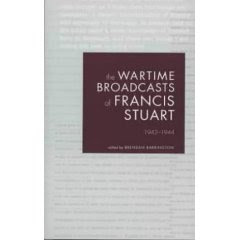
At the outbreak of War, in 1940, Stuart deserted his family, to teach in Berlin. He was now an admirer of Hitler: as late as 1995 he said:
I did see Hitler, and in hindsight obviously I was wrong, as a kind of contemporary Samson, a superman who would tear down the whole political and social system in England and Ireland.
In Berlin Stuart set up with a student, Gertrude Meissner, and made over a hundred broadcasts for the Nazis.

At the end of the War, he was arrested by the French in Austria. The Irish authorities studiously ignored his requests for a passport (which was the point of Malcolm's earlier reference), so he lingered in incarceration at Freiburg until 1946. Still with Meissner, first in Freiburg and then removed to Paris (where he associated with Sam Beckett), he produced a couple of self-exculpatory, autobiographic novels derived from his wartime experiences. Days after the death of Iseult, Stuart married Meissner in London (1954): by now Gertrude had become “Madeleine”, the dutiful hand-maiden.

After a further series of repetitive, unsuccessful novels, in 1959 Stuart and “Madeleine” set up house in the County Meath. There he laboured on Black List Section H, finally published in 1971: this is (for a particular audience) as successful a piece as any of his writings.

With that small achievement, he moved to a Dublin suburban bungalow. Colm Tóibín indicates that Stuart was closely involved with Andy Tyrie and the Belfast para-miltary UDA at this period. Madeleine died in 1986, and soon after Stuart remarried, this time the artist Finola Graham, his junior by over forty years (and whose CV pointedly omits any reference to Stuart).

Thereafter Stuart troubled the obituarists only occasionally.

Stuart, anti-semite?

Aosdána, the Irish Arts Council, elected him one of their seven Saoithe (“wise men), the Irish literary pantheon. Stuart did a 1997 inverview for a Channel 4 programme, A Great Hatred, which was predicated to Irish anti-semitism. The interview produced a typical Stuart quotation:
The Jew was always the worm that got into the rose and sickened it. Yes, but of course I take that as praise. I mean all those so-called healthy roses, they need exposing – many of them are sick.
This renewed interest in Stuart's wartime activities. A delicious literary/political spat ensued. The poet Maire Mhac an tSaoi, herself daughter of Seán MacEntee, one of the founders of Fianna Fáil, and wife of Conor Cruise O'Brien, took exception to Stuart's election, and campaigned for his expulsion (when she lost, she honourably resigned her membership and her pension from the fund). Stuart was saved from expulsion from
Aosdána by Anthony Cronin doing a line-by-line exposition of his work. A Kevin Myers article in The Irish Times prompted Stuart to sue for libel and win damages (Brendan Barrington's book, noted above, suggests Myers had some strong grounds).

Stuart, nihilist

Perhaps the shrewdest judgement is that of Tóibín, originally for the Irish Independent:
Stuart (and indeed H) would become a Republican, even though the politics meant nothing to him; and later in the 1930s when liberal opinion (and indeed most other opinion) considered Hitler’s Germany to be a place of evil, he would go there, he would live there during the war, he would broadcast to Ireland, and he would know what the consequences were going to be. And all this, his novel Black List, Section H makes clear, had nothing to do with politics, with anti-semitism or fascism, or Nazism, but arose from something darkly and deeply rooted in his psyche – the need to betray and be seen to betray. It arose from something else too – a passionate belief that every organised structure, and that includes liberal democracy, is rotten.
The End?

He removed to the County Clare, where Finola Graham has a house, and died in an Ennis hospital. He was buried in the same coffin as his cat, which pegged out at the same time. Sphere: Related Content

Wednesday, October 31, 2007


Shades of green
or how handling Michael Collins's inamorata fuelled Malcolm's drink habit

There are many enjoyable ways of irritating Malcolm, but two came together this week. One was a particular song; the other was a lapse of memory.

The link between the two was Four Green Fields.

Pub songs

The late Tommy Makem did a lot of good work, but his 1967 song, of which he was inordinately proud, grates on Malcolm. Makem in performance made it just a trifle too saccharine sweet and maudlin for Malcolm's palate. The New York Times's Neil Strauss implied something less than boundless enthusiasm, too, in his review of the 1999 New York Fleadh:
... backed only by an acoustic guitar, Tommy Makem bellowed a stentorian ''Four Green Fields,'' the hallowed Irish leave-us-alone-with-our-beauty ballad he wrote in 1967, as the audience members pumped their hands in the air and sang in spellbound unison.
Perhaps Malcolm is being over-pernicketty here, but over the years he has fallen out of love for the whole Clancy and Makem Oirish soft-soap, which owes more to the White Horse, Greenwich Village, than Malcolm feels comfortable with.

He totally sympathises with Dominic Behan for what Liam Clancy did to The Patriot Game. Cutting the references to Connolly and de Valera changed the whole tone, making an apology for blood-sacrifice out of a much more bitter, darker, socialist text (here with both versions):
This Ireland of mine has for long been half free,
Six counties are under John Bull's tyranny.

And still de Valera is greatly to blame/So I gave up my Bible, to drill and to train
For shirking his part in the patriot game/To play my own part in the patriot game.
Hardly a game

If anyone is not aware of the background to Behan's song, it relates to the shambles that was an IRA attack on the RUC Brookeborough Barracks on New Year's Eve, 1956.

Seán Garland's dozen Volunteers rode a commandeered dumper truck into town, and parked too close to their target, thus warning the RUC men within (who would have been alert after previous IRA activity in "Operation Harvest"). Under covering fire, the Volunteers tried unsuccessfully to plant a mine, but were driven off by return fire from the RUC sergeant. The IRA men retreated to the mountains, recovering the badly-wounded Seán South and Fergal O'Hanlon, both of whom died, in Dublin's Mater hospital, within hours, of "motor accident" injuries.

The main consequence of these events, apart from the ballads adding two more heroes to the pantheon, was Seán MacBride wrapping the green flag tightly round him, and causing the downfall of the Dublin coalition government and of his own political career.

The most beautiful woman in Ireland

MacBride's mother, Maud Gonne, is the link back to what Malcolm expects is the origin of the "Four Green Fields" metaphor for the four Provinces of Ireland. She appeared in the title-rôle of a one-act play,
Cathleen ni Houlihan, on April 2, 1902 at St. Teresa’s Hall in Dublin. WB Yeats (who would hardly have been neutral) later said of the performance:
Miss Maud Gonne played very finely, and her great height made Cathleen seem a divine being fallen into our mortal infirmity.
Euuugh!

The setting is the 1798 Rising, near Killala, at the moment of the French landing. The climatic moment, and mathematical centre of the play is:
BRIDGET: What was it put the trouble on you?
OLD WOMAN: My land that was taken from me.
PETER: Was it much land they took from you?
OLD WOMAN: My four beautiful green fields.
Immediately after that:
PETER: [to Old Woman] Did you hear a noise of cheering, and you coming up the hill?
OLD WOMAN: I thought I heard the noise I used to hear when my friends came to visit me.
We then are given the notion of the blood-sacrifice:
OLD WOMAN: ... there were others that died for love of me a long time ago. MICHAEL: Were they neighbours of your own, ma'am?
OLD WOMAN: ... There was a red man of the O'Donnells from the north, and a man of the O'Sullivans from the south, and there was one Brian that lost his life at Clontarf by the sea, and there were a great many in the west, some that died hundreds of years ago, and there are some that will die to-morrow.
Having thus name-checked the national martyrs, from Aodh Rua Ó Domhnaill to Donal Cam O'Sullivan Bere, not omitting Brian Bóruma mac Cennétig, she identifies herself:
BRIDGET: You did not tell us your name yet, ma'am.
OLD WOMAN: Some call me the Poor Old Woman, and there are some that call me Cathleen, the daughter of Houlihan.
The message:
Many that are red-cheeked now will be pale-cheeked; many that have been free to
walk the hills and the bogs and the rushes will be sent to walk hard streets in far countries; many a good plan will be broken; many that have gathered money will not stay to spend it; many a child will be born and there will be no father at its christening to give it a name. They that have red cheeks will have pale cheeks for my sake, and for all that, they will think they are well paid.
A terrible beauty

A powerful myth, but not one that Yeats created. Indeed, there is some doubt to what extent the play is his. Lady Augusta Gregory claimed the the opening scene, and that the rest was her and Yeats. Yeats himself would later wonder:
Did that play of mine send out
Certain men the English shot?
Did words of mine put too great strain
On that woman's reeling brain?
There is, indeed, a direct link from Cathleen ni Houlihan to Easter Monday, 1916. Malcolm will return to that in a later posting, and try to ascertain where the notion began.

In this respect, one is either with Yeats or with Joyce. Yeats (who had briefly flirted with the IRB) knew the effect his play would have, and deliberately willed it. Joyce, according to Stanislaus in My Brother's Keeper, "was indignant that Yeats should write such political and dramatic claptrap."

So, with one bound, we are into the psychology of Pádraig Anraí Mac Piarais. Malcolm has long been exercised by this, and fortunately even the most extreme of Pearse's apologists now have problems with it:
Many revisionists point to extracts from Pearse's writings to support the blood sacrifice thesis. Yes, without doubt, Pearse's use of language was often extreme, but also - and this should not be overlooked - typical of the age.

"Typical of the age", perhaps, and frequently blamed on Sigmund Freud, though, as far as Malcolm can see, Freud's key text did not become available until after 1918.

Beauteous Mary

Paul Muldoon suggests Pearse's poem Christmas, 1915 takes the notion of blood-sacrifice a stage further:
Pearse is ... only too conscious of the image of Christ in the arms of his mother, the mother being Ireland, the 'pierced' Christ Pearse himself ... That the coming battle should be joined at Easter, when Pearse/Christ might be expected to triumph over death by welcoming it, was a brilliant piece of timing, one that assured the longevity of the term "Easter Rising", and gave Pearse an emblematic status as the main rhetorician of Irish nationalism. I'm referring, of course, to Yeats's distinction between rhetoric and poetry, one stemming from a quarrel with others, the other from the quarrel with oneself.
The truth is that it the blood-sacrifice seems particularly and sadly persistent in Iris
h myth and iconography (and, as promised above, a topic Malcolm will return to). In the context of Cathleen ni Houlihan, though, a more promising and immediate route is through Lady Gregory's youthful reading of Sheridan LeFanu.

Translucent beauty


As we said at the outset of this entry, Malcolm was annoyed with himself because he could not immediately relate to the source of the "Four Green Fields" metaphor. He got stuck on Evie Hone's 1939 stained-glass window (illustrated). Hone made this for the Irish pavilion at the 1939 New York World Fair. It then came back to Ireland, and, years later, was displayed in O'Connell Street, in the CIE head office. Then it went back into storage, before finally being accorded a place in the Government Offices at Upper Merrion Street.


There's obviously a story behind Hone's design: there is an earlier 1938 design showing Saints and Scholars with St. Colmcille, more typical of Hone's religiously-inspired work. Who made the change to the more political motifs for the finished work?

Before Malcolm leaves Cathleen ni Houlihan and her small-holding problems, there are two other thoughts he appends.

Beauty and the beast

The first is a curious political inversion. Her image was conscripted by the British Government for recruiting posters, during the First World War, as these examples show:


The most beautiful girl in the Mid-West

Then came the stunning magnificence of the Irish maiden who featured on the Irish banknotes between 1928 and 1975. They went out of circulation in 1982, but the £100 design was used until 1996. She was derived from a portrait by Sir John Lavery.

The Notes Committee of the Central Bank of Ireland approached Lavery, an Ulsterman who had sided with the Nationalists, and whose house had been Michael Collins's (of whom more in a moment) London base in the Treaty negotiations.

Here's an account of the intention:
In preparing the portrait for the note, it was Lavery’s intention to produce a painting of Cathleen ni Houlihan, the legendary heroine who had been made popular by William Butler Yeats. Interestingly, Lavery was known to have in his possession at his death a portrait by Sean Keating, a young Irish artist, which was titled ‘Cathleen ni Houlihan’. It is possible that ownership of this painting predated his commission by the Note Committee and this work may have influenced his portrait.

Lavery worked on his portrait over Christmas 1927 and evidently sent a photograph of the painting to the Note Committee ...

The final portrait shows ‘Cathleen ni Houlihan’ leaning on a Cláirseach (Irish harp), supporting her chin in her hand. She is dressed in simple Irish clothing, with the lakes and mountains of Ireland in the background.
The result was one of the most attractive (in all senses) currencies around: the high value notes (the "Persian carpets") were exquisite.

In this case Cathleen ni Houlihan spoke with a distinct Mid-West twang, all the way from Chicago. When she married Lavery it was a second marriage for both of them. What causes much speculation is her relationship with Michael Collins and Kevin O'Higgins: was it more than flirtation? Collins certainly had a letter to "Hazel, dearest" in his pocket when he was shot. She went into mourning for his death. The current mode is that the relationship went unconsummated: this is, apparently, based on the assumption that, if had been been, the IRA would have shot her as a possible double-agent.

That ignores the obvious rider that Collins ran the gun-men and IRA intelligence.
______________________________________________

And if you must have Four Green Fields on your iPod, do as Malcolm does, and make sure it is Dick Gaughan giving it an authentic angry edge.

Sphere: Related Content
Subscribe with Bloglines International Affairs Blogs - BlogCatalog Blog Directory
 
Add to Technorati Favorites