Showing posts with label Presidential Election. Show all posts

Friday, October 16, 2009

A guaranteed emetic

Following that previous posting about "world peace", here's some more on the same lines:
I would like to extend warm birthday wishes to Margaret Thatcher today. Baroness Thatcher continues to remain a role model to many people, particularly women, around the world. Her career is a collection of "firsts." She was the youngest female Conservative Party member to stand for election in history, she was the first woman to hold the title Leader of the Opposition, and she was the first woman to become Prime Minister of the United Kingdom.

As Prime Minister, she took an active role in defending economic freedom and democratic ideals. Her push to privatize British industry and lower tax rates led to a substantial economic expansion in the United Kingdom. She was just as influential in foreign policy. Along with President Ronald Reagan and Pope John Paul II, Prime Minister Thatcher recognized the evil of Communism and worked tirelessly to erode the power and influence of the Soviet Union.

Her life and career serve as a blueprint for overcoming the odds and challenging the "status quo." She started life as a grocer's daughter from Grantham and rose to become Prime Minister - all by her own merit and hard work. I cherish the accomplishments of Margaret Thatcher and will always count her as one of my role models.
Published on the Facebook page of that equally inspiring (small "c") conservative thinker, and (absolutely minuscule "s") small-town politician, Sarah Palin. Who singularly failed,
  • generally,
and
  • specifically in that paeon to acknowledge the contribution made by a millionaire husband, prepared to fund his wife's little eccentricities.
Palin? Remember her? Sphere: Related Content

Wednesday, September 30, 2009

Athletic Dysfunctions

Today's New York Times:

Dementia Risk Seen in Players in N.F.L. Study

A study commissioned by the National Football League reports that Alzheimer’s disease or similar memory-related diseases appear to have been diagnosed in the league’s former players vastly more often than in the national population — including a rate of 19 times the no rmal rate for men ages 30 through 49.
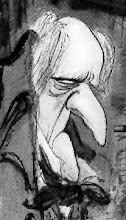
No prizes for noting the link between that news item and the picture, above right, and deducing where Malcolm is going here.

The minor thesis


This is a matter of continued dissension in the extended Redfellow clan.

Number one daughter, now residing in the Garden State (though well away from the poison belt) has taken to referring to "Soccer". Number three daughter (Saracens supporter) recognises just two variations of the ball game: football (round stuff) and rugby (prolate spheroids). As for Malcolm, he just drools and mutters along the lines of:
Football: a game for gentlemen, played by gurriers;
Rugger: a game for gurriers, played by gentlemen;
Gaelic: a game for gurriers played by gurriers.
A Malcolmian aside

In passing, it is curious that "gurrier", a word well-known in Dublin, is totally absent from the Oxford English Dictionary. One suggestion, from elsewhere, is that it is derived from the French "warrior" (guerrier).

Malcolm would venture a connection to the good English word "gurry", which could be cognate with "slurry". For example, just as Montezuma's Revenge (which term is in the OED, with a citation from the Church Times of 21 June 1996, locating its prevalence in ... the Kalahari) is a well-known ailment in central America, so Cromwell's troops in Ireland justly suffered from "the gurry".

Back on the pitch

Among the cis-Atlantic side of the Redfellow tribe, nobody has a clue about the rules of "American football", but suspects it is to proper football as Americano is to real Italian coffee.

The major thesis

Once again we have conclusive proof of the wit and wisdom of the late Lyndon Baines Johnson (obviously that does not extend to his involvement in South-East Asian affairs).

He, it was, who diagnosed the mental capacity of the (uniquely unelected) 38th President, and his successor but one:
Gerald Ford played too much football without his helmet on.
Apparently untrue (though the picture, right, seems to confirm the observation), but acute and mordant. As was LBJ's other remark, often bowdlerised:
Gerald couldn't fart and chew gum at the same time.
Sphere: Related Content

Wednesday, September 17, 2008

Flywheel, Shyster and Mooseblaster

Just when the whole Sarah Palin saga reaches a nadir of credibility, along comes something even more eye-openingly bizarre.

So, yesterday John Nichols blogging at The Beat, courtesy of The Nation, was noting:
... the McCain campaign's determined effort to shut down the investigation of Alaska Governor Sarah Palin's abuses of power in what has come to be known as the "Troopergate" scandal.
Now, we've had numerous "-gates", ever since Nixon's plumbers had compression-nuts caught in the mangle, but it takes some doing to get a "-gate" to one's name while only a candidate.

Ex Alaska semper aliquid novum

Mrs Mooseblaster is being sold as a "maverick" and a reform candidate, and for that branding exercise to work, she needs to be "cleaner than a hound's tooth". Well, Mrs Mooseblaster's pitbull fangs are well recorded: they may not be Colgate clean. As Nichols says:

Palin stands accused of dismissing the state's public safety commissioner because he would not fire her former brother-in-law, a state trooper with whom the governor was feuding after he and her sister divorced.

If Palin did so abuse her office, she could face any number of penalties, up to and including impeachment as governor. That would make it harder to pitch Palin as an "original maverick" reformer.

That throws the review of Governor Palin's actions back to the Alaska legislators. They are overwhelmingly Republican, but:

  • have personal reputations at stake, in a State where the Republican Party has a dodgy past -- Palin herself made it to the Governor's mansion by dissing her predecessor, and elements of her (adopted) Party;
  • have no particular reason to show Palin any great loyalty. If she makes it to Number One Observatory Circle, there'll be a vacancy at home; if she doesn't, she'll be shop-soiled goods; and
  • (again from Nichols):
Alaska is a very small state where top Democrats and Republicans have traditions of working together -- especially on ethics inquiries.
So, the McCain campaign is going via the tradesman's entrance:
McCain's aides have gotten a handful of legislators who are tied to the campaign to file a suit in Alaska's Superior Court demanding that the investigation be halted. The clear goal is to prevent the completion of what is likely to be a damning report regarding Palin's misdeeds before election day -- as was evident when McCain aides suddenly began appearing on national news shows, fully briefed and ready to cheer on the suit, just moments after Alaskans learned it was being initiated.
In short, the McCain campaign is launching an action against a committee of the Alaskan legislature, eight Republicans and four Democrats, to prevent the truth coming out before 4th November.

Chicken-and-egg: question and answer

There is a case to be made for the McCainites: Governor Palin becoming such a national personality has made Troopergate into a partisan issue. But that, in itself, raises a different matter -- what did the McCain camp know about the Mooseblaster life and times before she was rushed to centre stage?

We are assured that the background scrutiny of Palin involved a three-hour interview and an eighty-item questionnaire.

Malcolm would love to know how that questionnaire worked. There would, inevitably, be one question, on the lines of "Is there anything in your private life which could emerge and embarass the Party and the campaign?" Was the Miss Mooseblaster pregnancy then discussed and discounted? Was the messy scandal over the Mooseblaster sister's divorce explained? Or, are the McCain team now involved in a continuing fire-fight to contain a potential Towering Inferno?

The song she kept singin' made a man's blood run cold When it's springtime in Alaska, it's forty below

It's worth taking the temperature in Alaska:

At issue is whether Palin abused her power by pressing the commissioner to remove her former brother-in-law as an Alaska state trooper, then firing the commissioner when he didn't.

The matter risks casting a shadow on Palin's reputation, central to her appeal in the campaign, that she is a clean-government advocate who takes on entrenched interests -- not a governor who tried to use her authority behind the scenes to settle a personal score.

(Steve Quinn for AP in the Anchorage Daily News).

The investigation into whether Palin abused her office by putting pressure on Monegan to fire her ex-brother in-law has become more heated since Palin was named the Republican vice-presidential candidate.

The Legislative Council, made up of four Democrats and eight Republicans, voted unanimously to investigate the circumstances of Monegan's dismissal. Although Monegan was an at-will employee who could be fired for almost any reason, lawmakers wanted to see whether Palin tried to use her office to settle a personal score with Wooten.

Before Aug. 29, Palin told reporters she welcomed an investigation because she has nothing to hide. Since being named to the Republican ticket, however, Palin now has a lawyer defending her during the investigation and representatives of the John McCain presidential campaign are now involved.

(Michael Rovito for the Frontiersman, the local for Wasilla.)

It's worth recalling a throw-away comment by a local newsman, when Palin's nomination was announced: despite the claims by the McCain team that she had 80-per-cent approval ratings in Alaska, he pointed out the actual numbers were in the sixties, and falling sharply. He then added, "but they're in the teens among local journalists".

Out of the State, the Kansas City Star sums it up with an op-ed which starts:

Sarah Palin becomes just another politician

So much for Sarah Palin's claim to be a maverick, someone who doesn't play politics the old-fashioned way. Now she is.

The character issue

Mooseblaster and her doings amount to a very small "-gate". Far more important is what it says about the judgment and methods of McCain.

McCain spend much of the Primary season running against his own Party (in view of the unpopularity of the President, even among Republicans, that was a no-brainer). It tallied with his record in the Senate: on tax, immigration, economic policy and much, much more. He went to his nominating Convention on a simple ticket:
The nominee's friend described him as a "restless reformer who will clean up Washington." His defeated rival described him going to the capital to "drain that swamp." His running mate described their mission as "change, the goal we share." And that was at the incumbent party's convention.

After watching two political conclaves the last two weeks, it would be easy to be confused about which was really the gathering of the opposition. As Senator John McCain accepted the Republican nomination for president, he and his supporters sounded the call of insurgents seeking to topple the establishment - even though their party heads the establishment.
(Peter Baker, New York Times, and generally syndicated.)

The shine is coming off that model. The more McCain resorts to the "old politics" for his methods (as is apparently happening in Alaska) and appeals to the coalition of conservatives and fundamentalists Karl Rove built for Bush, the less the "maverick" image can fit.

And a final horror

Towards the end of a long appraisal of McCain's foreign-policy attitudes, Jeffrey Goldberg in The Atlantic writes this:
In my conversations with McCain, however, he never appeared greatly troubled by his shifts and reversals. It’s not difficult to understand why: tax policy, or health care, or even off-shore oil drilling are for him all matters of mere politics, and politics calls for ideological plasticity. It is only in the realm of national defense, and of American honor—two notions that for McCain are thoroughly entwined—that he becomes truly unbending.

Equally, McCain has identified one of his "heroes" to be ... Henry Kissinger.

Yikes!!

And for Malcolm's next trick,
how the "maverick" McCain,
scourge of Wall Street,
contributed to the collapse of Lehman Brothers,
and much more.
Stay tuned to Malcolm Redfellow's World Service!
Sphere: Related Content

Friday, September 5, 2008

The fashion stakes


Malcolm guesses that "Tricky Dicky" Nixon is partly to blame. That story is worth revisiting: it tells us a lot about the workings of US political theatre.

So: a Malcolm aside:

During the 1952 Presidential campaign, Nixon's "slush fund" became an issue. The New York Post had a story that Nixon had taken $18,000 from Californian businessmen, on which Nixon had been drawing for his personal use. That might have gone away, had Nixon not gone into turbo-mode. His problem was the mud stuck because corruption had been precisely the claim he had directed at his previous political opponents. His first defence was to blame Communists for initiating a smear campaign. Everyone in his campaign, Nixon said, had to be "cleaner than a hound's tooth". The press, who had already worked out that Nixon was not that straight, were soon aiding the agitation for Nixon to be dumped from the ticket. Then Eisenhower, after a few days of hesitation,telephoned him, and gave him a soldierly instruction: "There comes a time, in matters like this, when you've either got to shit or get off the pot." Eisenhower, shrewd as ever, warned Nixon that the public reaction to a statement would decide whether or not Nixon stayed on board. On 23rd September, Nixon and his wife, Pat, mounted the dais at the El Capitan theatre, Hollywood. Nixon gave a virtuoso performance to the audience of 2,000 and (more important, and an innovation) to the television cameras. The portion that is generally remembered is when he denied that Pat had a mink coat: no, all she had was a plain republican cloth coat. That was followed by a piece of mawkish piety:
A man down in Texas heard Pat on the radio mention the fact that our two youngsters would like to have a dog. And believe it or not, the day before we left on this campaign trip we got a message from Union Station in Baltimore, saying they had a package for us. We went down to get it. You know what it was? It was a little cocker spaniel dog in a crate that he'd sent all the way from Texas, black and white, spotted. And our little girl Tricia, the six year old, named it "Checkers." And you know, the kids, like all kids, love the dog, and I just want to say this, right now, that regardless of what they say about it, we're gonna keep it.
Later, when Eisenhower (who, himself, had few illusions about Nixon) was asked how he took the speech, his reply was, "We're gonna keep the dog."
Flash forward to St Paul

On Wednesday, the wife of Senator John McCain, who apparently did not know how many homes he owned, was introduced to the audience by former school librarian, Laura Bush.

Cue some neat bitchery from Vanity Fair's Politics and Power blog:
It caught our attention, then, when First Lady Laura Bush and would-be First Lady Cindy McCain took the stage Tuesday night wearing some rather fancy designer clothes. So we asked our fashion department to price out their outfits.

Laura Bush
Oscar de la Renta suit: $2,500
Stuart Weitzman heels: $325
Pearl stud earrings: $600–$1,500
Total: Between $3,425 and $4,325

Cindy McCain
Oscar de la Renta dress: $3,000
Chanel J12 White Ceramic Watch: $4,500
Three-carat diamond earrings: $280,000
Four-strand pearl necklace: $11,000–$25,000
Shoes, designer unknown: $600
Total: Between $299,100 and $313,100
Obviously, "plain Republican cloth" is cut more generously these days.

Another Malcolm aside:

"Slush fund": that's an interesting one.

It goes back to an almost-respectable origin in the 1830s; and it's from the Navy.

Before refrigeration and other methods of food-preservation, meat on ship had to be pickled in brine. When it was boiled, most of the fat would be skimmed off into any spare barrel. This fat would later be sold; and the return went into the ship's "slush fund", to be used at the officers' discretion.

The term appears in a political context as early as 1894 (there is an earlier use, also in the Congressional Record, in 1874, but that seems to be in the original context of padding out officers' income). The reference itself is interesting: it is about the way $400,000 of John Wanamaker's money was used to influence the 1888 Presidential Election in favour of the Republican, Benjamin Harrison. Harrison repaid his debt by appointing Wanamaker Postmaster General.
Some things never change.
The defeated Democrat President in 1888 (he went on to serve a second term after the 1892 election) was Grover Cleveland. In the campaign of 1884, Cleveland had been accused of fathering an illegitimate child: he immediately admitted it, and went on, narrowly, to win the election. A further factor in 1884 was the New York Republicans calling the Democrats the party of "Rum, Romanism and Rebellion". The Roman Catholics turned against the Republicans, who lost New York State by just 1,100 votes, and with it the national election.


Indeed, some things never change.


Sphere: Related Content

Wednesday, February 6, 2008

California, here we come ... not.

Last week, Malcolm mused on the febrile state of the Republican Party. The odds are stacked against a three-in-a-row win for anybody, anytime. Add in declining electoral support, disenchantment with the President, a lack of cash flow: nothing looks rosy for November.

Meanwhile, across the gang-way, despite the Clinton-Obama continued Mexican stand-off (though perhaps metaphors involving Mexicans and immigration should be avoided at this juncture), the Democrats have room to cheer.

Malcolm was interested, then, to see the first thoughts from the LA Times on the California Primaries. Obviously, as yet, the final results are a way off, and there was a bit of column-filling to be done. So we were given a piece of news analysis by Cathleen Decker.

This addressed:
a hardening of the state's Democratic tilt and a proportionate drop in Republican support.
And the figures are pretty dire for the G.O.P.:
"To an objective observer, the trend is not the GOP's friend in California," said Don Sipple, a Republican veteran of national and statewide campaigns.
A look at registration figures bears him out: Democrats gained four voters in the last two months to every one gained by Republicans. That left Democrats at just under 43% of the registered voters. Republicans note that is a historic low. The trouble is that Republicans are lower: just over 33% of registered voters. (The fastest-growing segment, Independents, constituted 19.37%.)

A survey of 12 key counties, moreover, showed the difficulties facing Republicans. In all but one, Democratic registration inched up between September and the close of registration Jan. 22.
In all of the counties, the percentage of voters who are registered as Republicans dropped.

California has gone Democrat in each Presidential Election since 1988:
  • 2004: Kerry by 54% to 44%;
  • 2000: Gore by 54% to 42%;
  • 1996: Clinton by 51% to 38%
  • 1992: Clinton by 46% to 33%. This was the tipping point: previously California had an unbroken allegiance to Republican Presidential candidates, back to Tricky Dicky in 1968m and beyond. LBJ had caned Goldwater 59-41 in 1964; but that was exceptional: even JFK could not quite take California in 1960.
So it's way back to 1988, twenty years, since the California electoral votes went Republican: Bush 51% to Dukakis 48%. The demography is constantly moving against the Republicans.

As things now stand, 43% of the registered electors declare themselves Democrats, just 33% are republicans. Both those figures are historic lows: the main percentage increase is in the 19% Independents. That is no comfort for the Republicans: those Independents seem to be tipping 4 to 1 for the Democrat candidates this time round. All in all the Primary showed an increase of 150,000 Democratic voters, and a decline of 25,000 republicans.

Not surprisingly, then, the presumptions are:
  • the Democratic candidate, be it Hillary or Obama, will not spend much time or money rallying the vote in California;
  • the Republicans will have California written off, unless (and, again back to Cathleen Decker's item):
the focus ... would require a confluence of events: John McCain as the nominee, character as the defining issue and a decision that the cost of running a campaign [in California] is worth the exceptional expense it would take.
Independents' presence gives Republicans hope, but there is a consensus that they will vote Republican only if McCain is the nominee. McCain, the former prisoner of war in Vietnam who has made his name as a burr under the saddle of official Washington, is far more in their mold than other recent candidates.
That seems a desperate attempt to whistling in the face of adversity. Once a political fixer mutters "if", it's an admission of impending disaster.

So that's 55 Electoral College votes for Hillary or Obama. Only 215 more needed. Sphere: Related Content

Wednesday, January 2, 2008

Things can only get better?

Somewhere around the house/in a box in the attic/garage Malcolm has the script of Gore Vidal's 1960 play, The Best Man. Others may have come across the 1964 filmed version (also scripted by Vidal), which seems to be what's behind the ever-so-slightly salacious cover (left). Malcolm fondly recalls seeing this movie, on its first run, in one of Dublin's O'Connell Street cinemas.

The plot involves five men (this is 1960, after all) competing for the Party's nomination at the Convention. The leading contenders are William Russell (Henry Fonda in the movie) and Joe Cantwell (played by Cliff Robertson).

Russell is the East Coast intellectual with principles, largely based on Adlai Stevenson. His extra-marital involvements have alienated his wife, whom he now needs back on the scene for a veneer of respectability. Cantwell is the machine politician, a Nixonian conniver, who gets one particularly-memorable scene: as he drives the LA boulevard he flicks a pack of index-cards, listing the Convention delegates: "Buy him... burn him.".

In retrospect, Vidal seems to be depicting the two sides of John Kennedy. Apart from being a close Kennedy associate (until, typically, he fell out with brother Bobby), he had other means of insight.

Hugh D. Auchincloss (i.e. Standard Oil, so Malcolm draws a line to the Rockefellers and Bushes) had a second marriage to Nina Gore Vidal, and so became step-father to our lad. Auchinloss’s third marriage was to Janet Lee Bouvier, and so he serially became step-father to Jackie O. To shrink the East Coast political scene even smaller, Malcolm notes that:
  • Gore Vidal, through his mother, is a distant cousin of Al Gore; and
  • one of the Auchincloss-Lee Bouvier daughters dated a young John Kerry (whose mother was a Forbes, and his second marriage to a Heinz).
Back to The Best Man: both Russell and Cantwell need the endorsement of the aging, indeed dying President Art Hockstader (a hybrid of Eisenhower and Truman, and an Oscar-nominated rĂ´le for Lee Tracey). Malcolm now sees that Ronald Reagan came close to playing Russell on Broadway. Melvin Douglas got the part when Vidal over-rode his producers' proposal:
"I’m responsible for Ronald Reagan,’’ Mr. Vidal whispered... ‘’I turned him down for the part. They came to me and said, ‘What about Ronald Reagan?’ I said, ‘He is good, but I don’t think he’d be credible as a presidential candidate.’ I have always thought that if I had cast him, Melvyn Douglas would have become president. It’s been on my conscience ever since."
This long, boring circumlocution is Malcolm's build-up for the scene in which Russell approaches Hochstader. Hochstader presses Russell on his religious observance. Russell admits agnosticism. Hochstader has a devastating line which Malcolm recalls as: "Son, when I went into politics, you had to pour God over everything, like tomato ketchup."

On which note, now let’s see: so far the Campaign for 2008 has thrown up:
  • a Methodist married to a louche Southern Baptist (Hillary);
  • an indefinable liberal “Christian” who was registered as a Muslim at one of his schools (Obama);
  • a Mormon married to the daughter of an opponent of organised religion (Romney);
  • the usual quota of tub-thumping Baptists in Paul and Huckabee;
  • a clutch of Romanists in Richardson, Biden and the babe-magnet Giuliani (who has managed two divorces, one of which was a hot ticket for the scandal sheets, one annulment, two RC church marriages, spectacularly-public affaires, a gloriously dysfunctional family life ...);
and, possibly, even hopefully, despite the New Year’s Eve denial:
  • the statutory Jewish representation in the person of Mike Bloomberg, self-made ($11.5B+) but yet another Bostonian.
It surely cannot get weirder, but all is compatible and tickety-boo with the First Amendment ("no law respecting an establishment of religion").

So not too much has changed, which is why the play seems regularly to be revived, on or off Broadway, in Election years. A review of the 2000 revival hailed the performance of Christine Ebersole:
Her bellwether take on the scheming wife of Senator Cantwell is an ingenious blend of Pat Nixon’s studied looks, Lady Bird Johnson’s disarming delivery, Nancy Reagan’s rapacious loyalty and Hillary Clinton’s chilling ambition.
When Malcolm looks for resonances in the script and the film, he finds an obvious one is the use of the Ambassador Hotel, on Wilshire Boulevard, as the film's body-double for the play's Philadelphia setting.

This must have qualified as the most cinematic hotel on the face of the planet: IMDB cites no fewer than 89 titles. It was here, in Room 568, that Mrs Robinson (the delectable Anne Bancroft) exchanged body fluids with Benjamin Braddock (Dustin Hoffman). The Ambassador, of course, is no more: because of competition, modern fire and earthquake regulation, it closed in 1989; stood derelict until it was felled (excepting the Cocoanut Grove building) in 2005. Eventually, it may become the site for a school campus.

The Ambassador's political involvement included stays by seven Presidents: Hoover, Roosevelt, Truman, Eisenhower, Kennedy, Johnson, and Nixon. It accommodated Khrushchev on his 1959 trip. In 1968, off the Embassy Room, where Bobby Kennedy had just acknowledged his success in the California and South Dakota Primaries, Sirhan Sirhan booked his place in the pantry-corridor of Infamy. Later, the Ambassador housed the Jury during the nine long months in 1971 of the Charles Manson trial.

As it gets down-and-dirty in Iowa and New Hampshire, Malcolm celebrates the shenanigans with another speech from the failing President Hockstader: ''Oh, I tell you Bill, I feel wonderful!'' he says to Russell. ''Up all night -- on the go all morning, seeing delegates -- I tell you there is nothing like a low-down political fight to put the roses in your cheeks.'' Sphere: Related Content
Subscribe with Bloglines International Affairs Blogs - BlogCatalog Blog Directory
 
Add to Technorati Favorites