in Stroke City for a year.

That avoids the inevitable declaration of bias, genealogy, religion and politics: "Derry" or "Londonderry"? In the choice of the name one is absolutely exposed.
Malcolm has never taken it wholly seriously. He remembers, a third of a century ago, being member of a local government panel interviewing for a very senior appointment. One of the candidates had been employed in the Northern Irish civil service. Malcolm rose to the occasion. Over lunch and in the panel he pressed questions on the interviewee, except that, with each alternate sentence Malcolm switched from "Derry" to "Londonderry". The candidate, a highly-intelligent man, merely grinned and followed the usage without a fault: had it been a set at tennis, it would have gone to the tie-break.

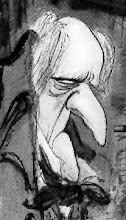
Derry native, Gerry Anderson (right) begat the alternative term, and it is available herefrom in his own dulcet tones.
Inevitably, any debate or discussion on the great Northern Irish divide, sooner or later, is sucked into the maelstrom of this single placename, from which there is no escape.
Once upon a pagan time there was an oak-grove ("doire" in Irish then and now). Patrick and the other Christian missionaries had the sense to adopt and adapt rather than try to erase and eliminate. So, Colm Cille, out of Tír Chonaill, great-great grandson of Niall of the Nine Hostages, founded a church on the site of this pagan fane. And so the site became Doire Cholm Chille, Columba's oak-grove.
Not much happened for a further millenium.

Then, in January 1600, Charles Blount, Baron Mountjoy, was appointed Lord Deputy. Malcolm may indiscreetly reveal in some future blog the "colourful" private life of Mountjoy (left). For the moment, though, it is salient only that Gloriana sent him to clean up the mess left by the Earl of Essex, and to deal with the O'Neill rebellion.
An essential part of Mountjoy's strategy was to place a garrison on Lough Foyle, and thereby force a wedge between the O'Donnells and the O'Neills.
On 16 May 1600, Sir Henry Docwra (who must, therefore, appear in the genealogy of Malcolm's alter ego) landed at Culmore, then advanced up the Foyle:
On the 22nd of May wee put the Army in order to marche, & leaving Captain Lancelott Atford at Culmore with 600 men, to make up the workes, we went to the Derry 4 myles of upon the River side, a place in manner of an Iland Comprehending within it 40 acres of Ground, wherein were the Ruines of an old Abbay, of a Bishopp's houses, of two churches, & at one end of it an old Castle, the river called loughfoyle encompassing it all on one side, & a bogg most commonlie wett, & not easily passable except in two or three places dividing it from the maine land.Obviously from this description, "the Derry" had hardly been a thriving community since Columba moved on to Iona.
In April 1609 Sir Thomas Phillips approached the City of London to plant the county of
 Coleraine, previously the territory of the O'Cahans. The City Companies drove a hard bargain with King James, and eventually secured the whole of Coleraine, plus a tranche of Tyrconnell, including the site of Derry: some half a million acres. That, in itself, was the insuperable problem: the liveried Companies could not drum up enough reliable Protestant tenants to occupy so vast a territory. However, it was now the City and County of Londonderry. It was also, self-evidently, geographically and psychologically a frontier outpost.
Apart from a nice line in le rat cuit à l'étouffée, life in Derry in the late 1680s was a trifle rough and tough. Derry was the largest town across Ulster, though perhaps little more than 2,000 in population (which makes the numbers quoted for siege-deaths somewhat suspect).
As sieges go, though, the 105 days seem to have been played quite genteelly. Hamilton, the attacker, allowed
 perhaps 10,000 bouches inutiles (another dubious number) to leave the city, which seems to deny the whole point of a siege. This changed when Rosen took over, held a round-up of Protestants and drove them under the walls, to be fed or starve as the defenders wished: this was more according to the rules, of course. The defenders responded by setting up a noose on the Double Bastion as a threat to any prisoners taken. Rosen then found he had a full-scale mutiny among his staff, and even James approved of his recall for "so cruel a contrivance".
Samuel Molyneux kept a diary when he travelled through the north of Ireland in 1708. He found Derry:
a good, large, compact, well-built town ... Since the siege ... it does not seem to be a place of much business, riches or trade.Jonathan Bardon continues from there:
Cut off from much of its natural hinterland by the Foyle, Derry did not alter its shape over a century after the siege, except for the growth of a modest Catholic suburb outside Bishop's Gate. Visitors, nevertheless, found the city attractive. The English travel writer, Charles Bowden, noted that 'the houses in general are remarkably well built, and the public buildings are very handsome structures ... The church is one of the handsomest I beheld since I left the metropolis.'And that was about it for a further century and a half. The city was at least reasonably prosperous on the back of shipping (especially emigrants off to become the "Scotch-Irish" of Appalachia) and cloth-making (the involvement of the London cloth-makers in the original plantation survived down to the famous shirt-factory). Derry and Carrickfergus were the only two towns in Ulster not to be pocket boroughs, and hold (by the standards of the time) "free" elections. We can see the legacy of commercial success in the fine houses that line Shipquay Street (right). Moreover:

Bishop Street, leading to the high south end of the walled city was less concerned with trade. Its development was less compact, with haphazard openings behind the street frontages to the Bishop’s house and garden, the free school and St Augustine’s Chapel of Ease on the west, and to the Cathedral and Church yard on the east. By 1788 the cathedral side of the street from the Diamond to Bishop’s Gate had been filled in completely. There are many images and descriptions of Derry during the 18th century. Most stress the picturesqueness of the place, not least, the philosopher George Berkeley - Dean of Derry from 1724 – 1732 who wrote:That is the old city, even if "Padua" seems a fancy too far, one which is now lost after 90 years as the last
'The city of Derry is the most compact, regular, well built town that I have seen in the King’s Dominions, the town house, (no mean structure) stands in the midst of a square piazza from which there are four principal streets leading to as many gates. It is a walled town, and has walks all round on the walls planted with trees as in Padua.'
In 1768 Frederick Augustus Hervey assumed the Bishopric of Derry. He brought a new conception of the role of architecture to the city. He restored the cathedral, redesigned the Bishop’s Palace and erected many new churches throughout the diocese but perhaps his most influential gift to the city was the first bridge across the River Foyle, built in 1789.

 outpost of the "United Kingdom" before Rockall (and notably so during WW2). The view from the ancient Walls is no longer a pretty one (left and top): a spew of modern housing reaching up the hillside to the Donegal horizon.
There are too many signs of neglect within the Walls: world-class old housing slipping into disuetude and cheap conversion, inappropriate in-filling, a general lack of care and investment, and hovering above it all that brutalism-on-steroids BT building.
For Malcolm, much of the pain came across in the song Phil Coulter wrote for Luke Kelly of the Dubliners. The Town I Loved So Well is a beautiful construction. The first three verses are plangently elegaic:
In my memory I will always seeSo far, so good. But this is no ballad to be let anywhere near your average Oirish pub singer. After the instrumental break, the iron enters the soul of the last two verses:
The town that I have loved so well,
Where our school played ball by the gasyard wall;
And we laughed through the smoke and the smell
Going home in the rain, running up the dark lane,
Past the Gaol and down behind the fountain.
Those were happy days in so many many ways,
In the town I loved so well.
In the early morn the shirt factory horn
Called women from Creggan, the Moor and the Bog,
While the men on the dole played a mother's role,
Fed the children, and then trained the dog.
And when times got tough, there was just about enough;
But they saw it through without complaining:
For deep inside was a burning pride,
In the town I loved so well.
There was music there in the Derry air,
Like a language that we all could understand.
I remember the day that I earned my first pay
When I played in a small pick-up band.
There I spent my youth; and to tell you the truth
I was sad to leave it all behind me,
For I'd learned about life; and I found a wife
In the town I loved so well

Des Geraghty's "memoir" of Luke Kelly says much of it:But when I returned, how my eyes have burned
To see how a town could be brought to its knees --
By the armoured cars, and the bombed-out bars,
And the gas that hangs on to every breeze.
Now the army's installed by that old gasyard wall,
And the damned barbed wire gets higher and higher.
With their tanks and their guns, -- oh my God! what have they done?
To the town I loved so well.
Now the music's gone; but they carry on
For their spirit's been bruised, never broken.
They will not forget; but their hearts are set
On tomorrow and peace once again.
For what's done is done; and what's won is won;
And what's lost is lost and gone forever.
I can only pray for a bright brand-new day,
In the town I loved so well.

Like all masterpieces, that song and its singer had universal appeal. Little else did as the '70s unrolled and circumstances became increasingly complex. Daily life in Northern Ireland began to ring with the calamitous echo of Clarence Mangan's apocalyptic translation of Róisín Dubh - 'O! The Erne shall run red with redundance of blood' ...These days there is something of Coulter's brand-new day in Derry. Despite the curious cross-sectarian factional alliance, inevitably hostile because that is what both sides do so well, the Eglinton Airport is becoming a significant local success. The rail link to Belfast has been saved; may be up-graded (the main requirement is a passing loop at Ballykelly, say £10M or the price of a couple of good barristers), and might -- just might -- be restored south of Derry. Once again, there is a bustle for some of the week with new shopping centres. Foyleside brooks to become a new place for waterside apartment living. The army barracks are being redeveloped for private housing.
The days when The Dubliners could bring huge audiences of Catholics, Protestants and dissenters together in Belfast's King's Hall to join in choruses of both Orange and Green songs were suddenly gone - just as, decisively, were the times when the Miami Showband brought the young on to the same dance floor, far from the bigotry and tribalism of the older generations.

The fissures remain, however. The Protestant population of the west-bank City side is now down to just 500 (from some 18,000 in 1969). Not surprisingly, the ultras reach for hyperboles like "ethnic cleansing" (as is equally alleged, by the other side, for Carrickfergus, Larne and East Antrim).
OK, says Mr Everyman to Malcolm, we've walked the Walls, drunk deep in Becketts and Tracys, seen the murals ... what's left?

Malcolm has one suggestion: get inside the Tudoresque red-sandstone Guildhall. You are in for a surprise. Provided you can inveigle yourself past the Jobsworth on duty, you'll get to see the Edwardian glazing: indeed, it's so vivid it'll come to see you.
Every picture tells a story: this must be the finest assembly of (restored) early-twentieth century municipal glasswork around. It's certainly not chi-chi Tiffany; it's not even pretty; but -- by God and King George! -- it is impressive. Those worthy burghers certainly got their money's worth of pre-technicolor immortality.
And Malcolm ventures one more observation: because by "Derry" standards it's so politically-incorrect, they don't publicize it. So you'll probably be the only one there to see it. Sphere: Related Content