Tuesday, September 14, 2021

Fair exchange is no Robb-ery

 This one came about in the usual circuitous manner.

I re-used that earlier post on Michael Pye's Antwerp on politics.ie site. The exchanges drifted onto how mediæval monasteries were roadhouses on cross-country travel.

A poster made what, for me, was a strange claim: Europe's road network was near non-existent, and long journeys were dangerous. That begs the question: how soon did those Roman roads fall into disuse?

I take a passing interest in that, for my home cottage is none too far from the A19 from York to Thirsk — and that, once upon  a far distant time was how the Roman legionaries and auxiliaries tramped from Eboracum's Porta Dextra to Cataractonium (Catterick) and the Roman Wall.

The Itinerarium Antonini (the Antonine Itinerary) is a listing of the major Roman roads of Augustus's Empire, and lists some fifteen main roads, two thousand miles, across Britannia.

As Chesterton said:

Before the Roman came to Rye or out to Severn strode,
The rolling English drunkard made the rolling English road.

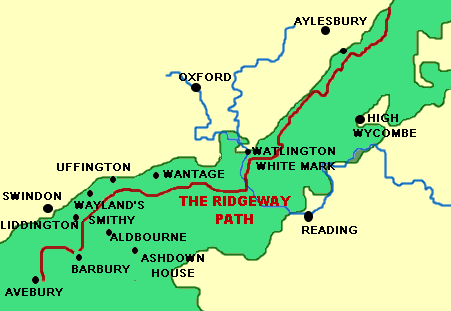
They weren't English: those Mesolithic track-makers came along eleven millennia ago. Perhaps here I reach for David Miles, The Tribes of Britain — or, better, leave that for another occasion. Whoever they were, they filled the landscape, and must have got around somehow. One of those ways, though not necessarily as  claimed 'the oldest road' would have been the Ridgeway:


If these routes pre-dated the Romans (as is generally agreed), they certainly took back their significance after Roman power in Britain fell. Henry of Huntingdon was commissioned (1129-30) by Bishop Alexander of Lincoln to compile a Historia Anglorum. Henry identified four royal highways: 
  • Ermine Street, from Bishopsgate to Lincoln, and onto York;
  • Fosse Way, from Exeter to Lincoln;
  • Watling Street, from the Channel ports in Kent, via Westminster, to Utoxeter on the Welsh border;
and 
  • Icknield Way, the line of the chalk escarpment that runs from Norfolk to Salisbury.
The Laws of Edward the Confessor, at least as re-invented by the Norman kings, declared these ways were under royal protection.

You may remember that this post was instigated by European history, not merely English. And that I'm not convinced mediæval routes across Europe were there to get from one Cistercian house to the next. More that the Cistercians needed to move their fleeces and sites their monasteries in good dsheep country, but also convenient to transport.

All this brought me to:

19: Graham Robb: The Ancient Paths.

Robb occupies several locations on my shelves. The Discovery of France and Parisians are with things French so bottom shelf, near the bay window. What I assume to be his latest, The Debatable Land is, for want of somewhere more frontier-like, high above my left shoulder, along with GM Fraser and Alistair Moffat

This one, though, is a bit of a lost soul: it wanders from travel (above right shoulder) to ancient European history (sort of near left side) as it feels appropriate.

I reckon that's because I haven't quite nailed down what I think of this book.

Its subtitle is Discovering the Lost Maps of Celtic Europe. For me, it's all a trifle too 'New Age-ist' — especially when he constructs a whole nexus of oh-so-precise geometrical connections. Try this one (page 275 in my paperback):

Scan.jpeg


Hmm: too convenient, think you?

So I'm not leaping to accept Robb's thesis of a Road to the End of the Earth following a solstitial line, bearing 57.53° east of north from sunrise through the Alps at the Col de Montgenèvre, near Briançon, all the way to sunset at Cabo de São Vicente. 

I don't chase ley-lines; but cannot avoid the 'sense of the numinous'. The trend in the 1920s was to look for spiritual markers. Alfred Watkins was the prime-mover in Britain. Wilhelm Teudt and his similar Heilige Linien" were doing something adjacent in Germany — but that was absorbed into the Völkisch movements, all that went with them, and so into post-War disrepute.

Scan.jpeg


I am, though, prepared to accept that our Celtic (and Germanic) illiterate forbears were (in every sense) crafty, and used 'natural knowledge'. Then, again, I've read too much Arthur C Clarke not to apply his apothegm, Any sufficiently advanced technology is indistinguishable from magic.

And yet ... and yet ...

Even before Rome, there were tracks across Europe. They may have been seasonal (what wasn't?); but all the evidence is they were there. Some were transactional (something as universally essential as salt needed to be moved): others seem to have particular and spiritual significance.

The Camino de Santiago — the path to Compostela — follows the Callis Ianus. That notion stems from a belief there was a cult of Ianus as far back as pre-Roman times. Ianus gets absorbed into the classical pantheon as the two-faced door-keeper of the classical gods — but curiously takes precedence in some prayers: Livy's History of Rome, Bk 8, chap 6, has the priest invoke:
Ianus, Jupiter, Father Mars, Quirinus, Bellona, Lares, divine Novensiles, divine Indigites, ye gods in whose power are both we and our enemies, and you, divine Manes, — I invoke and worship you, I beseech and crave your favour, that you prosper the might and the victory of the Roman People of the Quirites.

Ianus is the deity of 'beginnings' (January, anyone?) and so, inevitably, of endings. That's where we are all travelling: visit headlands facing the sunset, and spot the pre-historic burial grounds: the Celts and Scots chose Iona. All the pilgrim need do was follow the sunset to the 'field of stars' (
campus stellae, in case you miss the significance).


Sphere: Related Content

Monday, September 13, 2021

Would I were in Grantchester

 εἴθε γενοίμην. . . 

I can tell you that's optative mood. Latin manages just two moods — indicative and subjunctive, but the Greeks had already said 'Hold my Limnio!'and come up with a third. You have just been treated to a proper classical education in 1950s-60s Dublin.

Some present may recognise the expression: it's from Rupert Brooke's well-known celebration of Cambridgeshire:

... would I were
In Grantchester, in Grantchester! —
Some, it may be, can get in touch
With Nature there, or Earth, or such.
And clever modern men have seen
A Faun a-peeping through the green,
And felt the Classics were not dead,
To glimpse a Naiad’s reedy head,
Or hear the Goat-foot piping low: ...
But these are things I do not know.
I only know that you may lie
Day long and watch the Cambridge sky,
And, flower-lulled in sleepy grass,
Hear the cool lapse of hours pass,
Until the centuries blend and blur
In Grantchester, in Grantchester. ...

Gorgeous, pretentious, affected goo. Exactly what one expects from a privileged, effete Rugbeian. But — ooh — so emotive. Of course, the place and the poem come with all the trimmings. Byron swam nearby (Brooke gets that it). The village is the most up-market end of Cambridge, and it used to be an irregular number 18 bus.


If you detect empathy for the mosquito that got Brooke, you may have a point.

A Cantab once muttered his imprecations against his fellow alumni: 'The trouble with them is they spend the rest of their lives trying to crawl back into the womb of alma Mater.' I feel his pain.

One such is James Runcie, son of a former Archbishop of Canterbury. As I work it out, young Runcie was born while Runcie senior was dean of Trinity Hall — which, by a strange co-incidence, was young Runcie's college.

Young Runcie, though, made it in the big, bad world of media as a novelist, film-maker, and playwright.  And — perhaps more significantly — arts guru for the BBC.

In 2012, to gild a shining hour, young Runcie began a series of detective short-stories based on the fictional vicar of Grantchester. Either by intent, or calculation those six books provided a perfect basis for TV adaptation. Moreover, they had the quaint, cozy English feel that appealed to an American audience. The Runcie table would never be short of honey still for tea.

After half-a-dozen volumes of his Sidney Chambers, young Runcie went back to the fountain-head. And something quite remarkable came up:

18. James Runcie: The Road to Grantchester

We get four evenly-spaced 'Parts' — War, Peace, Faith and Love.

It starts:

London, 28 February 1938

They are in the Caledonian Club, dancing the quickstep. Sidney is eighteen. Amanda, his best friend’s little sister, is three years younger. The band is playing ‘Bei Mir Bist Du Schoen’: ‘To Me, You’re Beautiful’. He has asked her to dance out of politeness. He has good manners, everyone thinks so, but he enjoys the dance more than he had expected.

 Amanda Kendall is, of course, the on-off love-interest in the early Grantchester Mysteries. Then a crash cut:

No one believes there will be another war and, even if there is one, how can it possibly ruin the memory of this golden evening, with everyone in their finery, dancing on a polished wooden floor under the chandeliers with the orchestra playing and the candles ablaze?

Five years later, Sidney Chambers is on a transport ship with the 2nd Battalion, Scots Guards, preparing for landing south of Salerno.

Sidney's school- and Cambridge-buddy, Amanda's brother, Robert Kendall is in the same unit. 

We follow the blood-and-gore of the Italian campaign from Solerno to Monte Cassino. Sidney's problems with faith are implied: a visit to Mass at a ruined chapel, his occasional guilt, his exchanges with the padre:

'Rev Nev' Finnie is an Episcopalian from Markinch in Fife. He is an asthmatic in his early forties, technically too old for service, but he is a family friend of the Colonel. He has been offered leave but he has a determination to continue with his ministry, wherever it takes him, and people can’t be bothered to argue about his age or suitability. He is only a priest. There are plenty of soldiers to console and bury.

Page 69 (of 327) comes the crisis:

Kendall leads the advance; Sidney is behind with the Bren, waiting to open up when the German defence has weakened. It is a sustained cacophony, rifles firing, blazes of illumination, silhouettes of movement, men stumbling, falling, shooting, killing, dying; a sustained attack and then a lull; a moment for replenishing, rearming, reconsidering before another opportunity to take the initiative while both sides work out what to do next.

Sidney calls, ‘Down,’ and the men nearby fall low, allowing him a clear line of fire. But a few soldiers in the distance either haven’t heard or are confused about the battle orders and are scrambling back. In the darkness, it is hard to tell if they are Allied troops returning or whether it’s an enemy attack.

Sidney keeps firing. He can’t see Kendall, but then he can’t see very much at all in the melée. He only stops when he runs out of ammunition. Then he realises how many of his own men are wounded. He calls out for the stretcher-bearers. Where is the Advance Dressing Station? How soon can they get help?

One man is unconscious, bleeding from the neck and chest, his head to one side, his eyes open in glazed surprise.

It is Robert Kendall.

Two days later Sidney has a field promotion to Captain, and awarded a Military Cross. Robert Kendall gets a posthumous DCM. Sidney goes to 'Rev Nev' for some comfort:

‘Would you like to pray?’

‘I’m not sure if I can.’

‘Let me start for you.’

Rev Nev bows his head. ‘Merciful Father, look down on this, thy servant Sidney. Accept his penitence, calm his fears, bring him your peace, in the name of your son, Jesus Christ, who suffered and died for us. Amen.’

Sidney just manages to repeat the ‘Amen’.

A lesser writer might have skipped then to Sidney, post-War, taking Holy Orders. Runcie doesn't, but rushes the story through Sidney being wounded, cared for by an Irish nurse (hinted flashback to Sidney's earlier relationship), and the end of the War.

The reader now possesses Sidney's causes of guilt and of 'belief'. Post-war he is rootless: suggestion of a career in the Foreign Office, in teaching or whatever leave him inert, unmotivated. Amanda takes him to the National Gallery: 

They find themselves in front of Caravaggio’s Supper at Emmaus, Christ with outstretched arms in blessing, the two strangers suddenly realising who is with them, light in the darkness, the simplicity of bread and gesture, its distilled meaning. [...]

They study the picture in silence. It is an image of commanding serenity, perfectly proportioned in its beauty and stillness. He feels the painting is calling him. Christ is calling him. This is the peace that the world cannot give.


 Then follows a series of awkward exchanges: he meets 'Rev Nev' who arranges a retreat, he talks to his father, he tries to explain his intention to Amanda ...

From then there is a killing (involves a pair of duelling pistols, no great mystery), we follow Sidney through theological college, into his first parochial involvements in Coventry as curate to Canon Clitheroe (there's an awkward, youthful pregnancy which involves secrets needing to be confessed), he finds himself growing away from the social scene of Amanda and her family, until ...

On Easter Monday, Graham Clitheroe asks for ‘a serious conversation’. Sidney worries what this might be about. Has a parishioner made a complaint? He does not think he has been neglecting his duties. On the contrary, he has been working all the time. Perhaps the vicar thinks he has been too lenient with Julie Jordan? Or maybe someone has died? Or Clitheroe has decided to retire?

They sit in deep old sofas, inherited and in need of reupholstery, drinking sweet dark sherry that Sidney does not like but won’t say. There’s a loud clock too, and he wonders why people need to be so constantly reminded of time.

‘Do you fancy a trip back to Cambridge?’ Clitheroe asks. The tone is kindly, almost amused.

‘Why there?’

‘I’ve had a letter from the Bishop of Ely. I don’t think you know him, but he’s been asking after you. They need a new man in Grantchester and he wants to know if you might be ready for the task. It’s quite a job.’ 

The conclusion involves Sidney telling Amanda how her brother died, a finely written scene — any comment would be a spoiler.

The novel concludes with Sidney induction at Grantchester:

Sidney is supported by friends old and new: his parents and siblings [...] together with all the regular villagers, including Mrs Maguire, a fierce-looking woman who has been earmarked as his housekeeper, the Mayor of Cambridge, and Inspector Geordie Keating from the local police.

Sidney looks out into the congregation and spies Amanda at the back of the church. She must have arrived late and on her own.

They walk by the Cam:

‘I’d like you to answer another question,’ he begins.

‘Questions, questions, Sidney. Whatever next?’

‘Will you look after me, Amanda?’

‘That sounds like a proposal of marriage. You know I’m engaged to someone else?’

‘I think it’s more than that.’

‘More than marriage?’

‘Yes, probably, given our history, given all that we know about each other, given my hopelessly uncertain and impoverished future. . .’

‘And you expect me to answer that?’

‘I do.’

‘There you go again. Is that the only time you are going to use those two words in my company?’

‘Probably.’

Cliff-hanger ending.

All of that side-steps the question: to what extent is the story of Sidney Chambers at least partly an analogue of Runcie's father?

Robert Runcie served in the Scots Guards (✔︎ check), was in the Normandy campaign (not Italy), was awarded the Military Cross for acts of bravery ((✔︎ check), was a Classics scholar (✔︎ check), studied for ordination at Westcott House, Cambridge (✔︎ check), served as a curate in Newcastle, returned to Cambridge (✔︎ check), and then became Bishop of St Albans. Robert Runcie died in 2000.

Sphere: Related Content

Saturday, September 11, 2021

Something happened ...

No: not Joseph Heller's 'forgotten novel' — though I ought to get to Heller sometime. Just a thought about the moment English navigators and seamen looked across the Atlantic.

I doubt it was just Cristóbal Colón, antea Cristovão Colom, Cristoforo Colombo finding his way and naming San Salvador.

All the evidence is that the shipmen of Bristol (and perhaps places like Waterford) had gone beyond the Porcupine Bank and been fishing off Newfoundland for at least two decades before — and presumably had some idea of land nearby. They just kept that knowledge to themselves. Else, how do we explain John Lloyd in a small vessel out of Bristol (15 July 1480) heading out to look for the mythical island of Hy Brasil? Lloyd's cargo included forty bushels of salt — a bit of cod-fishing was obviously part of the deal.

There's more evidence in Hakluyt, who included in Principal Navigations a Robert Thorne's map and some memoirs. Thorne, in two letters (one to Henry VII Tudor, the other to Edward Lee, the English Ambassador to Spain), tells of his father having been involved in explorations of the Newfoundland coast, and urging the 'authorities' to get on with repeating it.

All of which, and far, far more suggests to my mind that 'Something was happening' in Tudor times to turn English attention to look west. The only question is when to date it.

Allow me to leap a very eventful century to 4 November 1576. That date was the sacking of Antwerp, and a period of anarchy for the Spanish Netherlands, which had all kinds of consequence. Out of that, the Union of Arras (formulating a core for the remaining Spanish power) and the Union of Utrecht (the cohesion of the United Provinces), both in late 1579, explain why the modern Netherlands (mainly lapsed Protestants) and Belgium (heavily Catholic, but no longer as sincere as they used to be) still persist. This was when the Habsburgs were realising the limits of Spanish power in the Low Countries. After, the main commerce centre moved north along the coast to Amsterdam. From a specific English point-of-view, it destroyed the main export wool-market.

And it's why I have been reading ...

17. Michael Pye, Antwerp: The Glory Years


I bought this book on the back of very warm reviews, and because I knew (and took to) Pye's earlier The Edge of the World, How the North Sea Made Us Who We Are — which is very much the other half of this story. In the matter of the city and history of Antwerp, Pye's two books overlap to the extent one may spot borrowings from one to the other: the same names flit from one to the other.

Another reason for acquiring this book was — I know and like Antwerp. Getting there is too easy — off the Eurostar at Brussels-Midi, change platform and the same ticket takes me the rest of the way. Antwerpen Centraal is gloriously theatrical, turn-of-the-nineteenth-century and splendidly over-the-top.

Belgium as a whole is the epitome of Northern European bourgeoisification. Antwerp must count as the country's most bourgeois provincial city. And the ultimate bourgeois bit of Antwerp is Meir, the fashion district. Money still talks here — but with style.

Pye's story of the great century of Antwerp, the sixteenth century. His account is topped-and-tailed by two events, making for a compact account (the text is barely a couple of hundred pages). It kicks off with the arrival of Portuguese Jews fleeing from the Inquisition, bringing their skills, trades and acumen. It ends with Alexander Farnese, duke of Parma, suppressing of dissent, enforcing Catholic conformity, and so with the flight of those Jews, of Lutherans and Calvinists to more congenial cities. In between is a period of liberalism, especially in economics. 

Hence the story never strays too far from money. The book is delightfully full of anecdotes and vignettes. This is from page 116, starting chapter 8 (which is entitled — yes — Money):

The banker and merchant Erasmus Schetz tried to explain money to his 'most special friend', the 'great and most learnèd man', the philosopher Desiderius Erasmus of Rotterdam. He was not doing well. 'I was certain,' Schetz wrote, 'that within a year I would have rendered you capable of understanding all this.' He added: 'I would prefer that you were more capable of grasping this matter than I see you are.'

Erasmus was expecting income from a parish in England, but the coins seemed to have different values in different places. Schetz had to tell Erasmus that there was money in coins and money on paper and the value of the two could shift, that other people could take the difference between the markets in money 'to their own gain, and to your detriment'. The great philosopher had a simpler view: he assumed he was being robbed.


Sphere: Related Content

Where were you when ... ?

 I'd finished a day teaching. Long since (formally) retired I was a locum at the local Roman Catholic secondary school. Locum in this case making me a 'supply teacher', the lowest of the low in the pedagogic pecking order.

It wan't by any means a 'bad' billet. My TCD degree gave certain credibilities (I'd mentioned that I wasn't RC; but that didn't seem to matter). I could, though, cope with the stuff others shied away from — A-level Milton kept me in fodder for several years. Above all, it more than paid the bills: what with a secure pension, and this daily screw I was better paid in retirement than I ever had been before. I was once, discreetly, told that and the 'on-costs' made me the third most expensive item on the school pay-roll, after the Head and the Caretaker.

So, sweat of a day behind me, I cruised home on the Yamaha, over Alexandra Park (ignoring as did everyone else, speed restrictions). I dropped down the run-in towards the garage. Removed my crash-helmet, reached for the garage key...

The kitchen door was open, and the Lady in my Life called out: "She's all right!"

Huh?

We had a small Sharp tv on a ledge in the kitchen, and it was tuned to the news-channels. The full horror was being revealed moment-by-moment.

The time difference meant that London around tea-time was coming up to noon in New York.

It took some while for everything to become clear.

Number 1 Daughter ...

... lived in suburban Noo Joisey, convenient to the 'Midtown Direct' trains into Penn Station. We'd been over a few weeks earlier, and trogged around Manhattan in steamy heat to exhaustion. Even to the point where we'd looked up and considered the tourist lift up the Twin Towers,  only to say, "No: they'll be there another time. Let's go, get a drink".

Number 1 Daughter was then working on an consulting assignment in the World Trade Center. Her husband was down in Texas on some job. So Number 1 Daughter, with au-pair, was caring for First-born, due into day care.

That was the morning First-born, in short order, filled and re-filled his nappy, so Number 1 Daughter missed two trains in succession.

Not-quite-alternate trains on that Morris & Essex line run into Hoboken, there the PATH or ferry runs to the World Trade Center. When Number 1 Daughter arrived at Hoboken there were, of course, no PATH no ferries — but all could see the smoke from the Twin Towers. The instruction was to go home — except, by then, the entire transport network was in total chaos, cell-phones were no longer working, and confusion was thrice confused.

It took hours for Number 1 Daughter to make it home. By that stage some sense of events had percolated through: Number 1 Daughter knew some of her team were down to DC that morning, and jumped to the conclusion they could have been on American flight 11. There was another shocker when she made it back to pick up First-born, by which time it was already approaching shutting-up-shop time. Only to find several other uncollected children, and an air of despairing panic setting in.

Meanwhile, deep in the heart of Texas ...

... a select cadre of business-types could hear and see what was happening in NYC, but couldn't communicate with home. Number 1 Daughter's husband managed a line of communication: he could 'phone his sister in California, who could 'phone us in London, who could 'phone Number 1 daughter once she was on the Noo Joisey network.

Without airlines, four business-types hired a car and drove non-stop the seven hundred miles to New York.

Yes, I remember 9/11.

Sphere: Related Content

Friday, September 10, 2021

The book of the show, the show of the book

 Right of my desk is one particular shelf:


Were this a 'library' and not, more prosaically, my 'book-room', this would be marked 'over-sized'. As that image shows, it has become where I stuff exhibition catalogues. There are two more, currently wandering free, to add. Both from our last trip down to The Smoke: the Tate doing Turner yet again, and the BM on Thomas Beckett.

Such vanities, at their ordinary norm, tend to be 'coffee-table books', casually left beside where, like pensive Selima, the Mistress or Master usually reclines, to impress a casual visitor on the depth, learnedness and perception of their sporter.

These glossy efforts should be something more than an ornament or a momento. That 'something' ought to add depth and understanding to the exhibition from which they originate.

As I imply, some are better at that than others. Many are definite improvements on the exhibition itself —  (editors) Gareth Williams, Peter Pentz and Maththias Wemhoff on Vikings, life and legend for the 2014 travelling show would be my best the best example.  Here's another:

16. (editors) Claire Breay and Joanna Storey: Anglo-Saxon Kingdoms, Art, Word, War

This is, by any avoirdupois, a heavy tome. It runs to over four hundred pages of quality art-paper.

Back in 2012 the British Library bought St Cuthbert's Gospel from the Jesuits (we'll come to that small history in a moment). The fund-raising was up to £9 million, which suggests the importance of this tiny piece (think 5½ x 3½ inches). We are assured that it will rotate between the BL and viewings oop north. The BL then had to construct an exhibition around its acquisition.  That's the occasion: this is the record.

The bulk of the exhibits were either similarly small — the Alfred Jewel, borrowed from the Ashmolean almost ridiculously so — or script based. It was like old-times to be back with the Book of Durrow from  the TCD Long Room — which prompts a wonder at the relative exhibition value of the other Book there, Durrow's younger-by-a-century sibling.

The star of that BL show was meant to be St Cuthbert's Gospel: the text of St John, written we must believe in the monastic scriptorium at Jarrow, and around a century after Cuthbert's death (AD687).  what makes it special is this is the oldest known bound European text. Its cover, then, is of greater intrinsic interest than the text.

After his death Cuthbert's coffin was repeatedly on the move, to keep it from intrusive Danes. it and his corpse eventually arrived at Durham. In AD1104 the monks decided to have a poke at the old lad, and found this book in the coffin.

When Henry VIII Tudor dissolved the monastic establishment at `durham, the Gospel and other saleables were put on the market. The Gospel ended up the property of Stonyhurst College. For many years the College left it 'on loan' with the British Museum/Library., until the Jesuits decided to realise its considerable value.

Unless one is into manuscripts, the exhibition was hardly over-whelming, whereas the depth and scholarship in the catalogue undoubtedly achieves that end. Only through the extensive annotations in the text do th exhibits (and their analogues mentioned, but not displayed) achieve a full context.

The exhibition had a chronology, spanning — let us remember — over six full centuries. It started with 'Spong Man' – the seated, unisex figure which must once have been the seal for a flask or a cremation pot, found at North Elmham. That is dated back to the early period of Anglo-Saxon occupation. It concluded with two versions of the Domesday Book — the Exeter Domesday and Great Domesday..

Just when one feels one should be reaching an end, the catalogue properly concludes with fourteen pages (!) of comprehensive bibliography.

Before I wrap up this post, I must add two particular memories from other exhibitions, and now to be revisited through these catalogues.

From the winter 2011-2012 National Gallery Leonardo show there were the two versions of the Virgin of the Rocks facing each other, and so ready to be compared and contrasted. Since the National already had one (the darker version from as late as 1506) bringing the Louvre's, earlier (1485-ish), prototype to London was something of an achievement.  It involved a mutual exchange deal, of course.

On 19 March 2018 (I have the ticket before me) I was at the Royal Academy for its Charles I, King and Collector show. A few of the stand-out highlights are listed here.  What that omits are the two gob-smacking royal portraits: the very domestic king in the Greate Peece (Charles I and Henrietta Maria with their two eldest children), and his grandest possible entry, Charles I with M. de St  Antoine.

The Commonwealth, ever short of cash, had a massive garage sale of all Charles's art-works. The items seem to have been valued by the yard: both are huge (around 3.7m by 2.7m). The mounted Charles went for £150:


Sphere: Related Content

Wednesday, September 8, 2021

How far could he push it?

 15. Richard Condon: thrillers on speed

Once upon a time, after growing up in Hell's Kitchen, NYC, and doing his stint in the merchant marine, Condon settled for the hectic life of a Hollywood publicist and agent. His boss, Max E. Youngstein at United Artists, skimmed his salary, banked it for him, and then sacked him, telling him to go look at the sea in Mexico and write the novel he had been promising.

Condon's second effort was The Manchurian Candidate (1959), which suitably reframed into an almost-conventional thriller, was filmed in 1962 (and remade in 2004 — though stick with the John Frankenheimer version). Condon needed never to work again.

But he did — I think his total oeuvre runs in excess of two dozen books. He drove deeper and deeper into the phantasmagoria of American conspiracy theory. Just as The Manchurian Candidate mined the hysteria of the Cold War, he later took on the Kennedy years, and the mafia (towards the end of his writing career, and not up to his best, four books on the Prizzi family).

Time and again Condon excoriates political corruption and how it destroys. In Manchurian Candidate, the mother-figure uses her damaged son to bring about an assassination which would make her husband the presidential candidate — the villain behind the curtain is thinly-disguised Senator Joe McCarthy. In Winter Kills (1974) a substitute 'Honey Fitz' machinates the assassination of his JFK-like son. Perhaps too often there a sexual perversity at work, as well: incest is implied in Manchurian Candidate (a posthumous study showed Condon, there, had ripped bits from Livia in Robert Graves's I Claudius).

If any one motive was the driving force, it was Condon's visceral disgust at power-games, power-exploitation in the leading political families and for Richard Nixon in particular. That is most evident in the central character of Death of a Politician (1978). Trump would have been grist to his mill.


I'm picking just one of his works, and not an obvious one: Mile High (1969) — which was put in the shade by Mario Puzo's similar, (and this is a strange thing to say about any Condon story) more sensationalist The Godfather.

It's another generational novel: a triple-decker — the three unequal parts are The Minotaur; Theseus and Wife; and The Labyrinth. There is a positive morass of characters, quit a number of excesive vices, and a smattering of over-the-top virtues and their singnallers.

Paddy West is the grandfather, in Famine Ireland:

The blight came on in ’45. The famine began in ’46. Dysentery and relapsing fever followed. Thousands roamed the countryside praying for food, eating thistles to stay alive. They began to leak out of their country. First to Liverpool, Glasgow and South Wales, then to Australia, last but most powerfully to the United States, jammed starving and diseased into unseaworthy ships.

A million died at home before Paddy West got away, including three brothers and four sisters. The British at last had begun to issue corn, but the Irish didn’t know what it was and most of them couldn’t or wouldn’t eat it. Paddy filled his pants and a sack with it and made himself eat it after he saw how they cooked it, but on the road from Killarney to Cork he preferred to eat weeds. But he had luck. He came on two drunken English soldiers and in the right place for it, so he clomped them both on the heads with a flat rock and found six shillings in their pockets, all unaware that he had started on his life’s work. He ate the corn, cooked or raw, and watched for lonely soldier drunks at night until he earned enough for his Cunard passage — about twenty American dollars’ worth.

Paddy West then involves himself in the seamiest aspects of New York life  — and (for me) sketches a dystopic criminal and political corruption. West rises though 'crimping' — shanghai-ing crews for ships on behalf of Ma 'the Casker' Steinet — and politicking with Tammany Hall:

After Ma died Paddy set his course for politics [...]. He leased the three boardinghouses to Charley Gleason. He sold the slop shops to Larry Meagher, and over the twenty-two years with Ma and his bands of fancy girls and his various overrides he had saved forty-one thousand dollars and he now owned leases and buildings and land. When he burned the boardinghouses that stood between Fulton and Wall Streets after the leases expired, he collected another three thousand in insurance. He built tenements on the land with a good bank loan that the Party arranged for him at fair rates.

With all that comes money. Paddy sires Eddie on a Mafia bride. Eddie is cultured into being a businessman:

Edward Courance West at twenty-one became the youngest bank president in the history of the state. The bank was three blocks west of Tammany Hall, which had moved uptown from Franklin and Nassau in ’68. To install his son, Paddy had torn down the building the street-level store was in and built a four-story edifice, with a vault for the sweet little bank whose capital was now eight million, two hundred and ninety-one thousand dollars and eleven cents (as of the 1909 year-end audit).

When Paddy died suddenly after a lifetime without a sick day, Eddie was twenty-three years old: March 24, 1911.

Paddy dies in the company of Willie Tobin, who continues as the father and son's go-fer to the end. Eddie is the central part of the story. He comes up with the ultimate heist:

To Edward Courance West the prohibition of alcohol was merely the greatest business opportunity since the Industrial Revolution. He did not see it as an infringement of rights [...] All he saw, very simply, was a chance to make two or three billion dollars and to evade taxes on all but a minuscule fraction of it.

While agitating for prohibition, Eddie has also squared Don Vito of the Sicilian mafia to provide the labour to distribute illegal hooch. Which led to involvement in organised labour (or rather exploiting it).

Eddie's marriage turns sour: his ultra-Catholic wife is appalled at his violence to prostitutes (this, as only happens in fiction, will coincidentally return in the final section of the novel). Eddie becomes convinced his partner is having an affair with her (Eddie convinces himself it is all part of a Commie plot). He catches them together, and destroys his house out on Long Island. The wife dies in childbirth. Eddie abjures  the child.  Etc., etc.

Eddie falls for a chorus-girl, sets her up in an apartment, only to find she betrays him with the 'companion' Eddie had arranged to watch her. Eddie goes totally nuts. All this, and much more.

The story then changes gear. With Eddie out of his mind,  we move to the third generation. Walter (named for his maternal grandfather) has a complex history. He serves as a rifleman in Korea, becomes a priest, then a respected architect, never a criminal.  And, obviously, a meg-millionaire on the back of his inheritance and then Eddie's management of his funds. He marries Mayra Ashant, an artist on a West scholarship. When Mayra is told Walt is the son and heir of Eddie:

Mayra had felt cold hostility cover her like hair spray and hold her in a rigid net. He was the son of the West Foundation. They’d been together for three months and she had thought they’d been everything it was possible to be to each other, but he had been afraid she would find out who he was, because she was black and he was ashamed of her. So many things he did habitually began to convince her more and more that he had just been using her until he got tired of using her. Like the way he was so cheap, pretending to like Swiss champagne more than French, or always taking buses, or having two suits of clothes to his back, all so she wouldn’t think he was that rich man’s son and try to take him the way he figured that’s what she’d do the minute she found out. And the way he babbled about astrology, and theosophy and faith cures and nature healing, just like he was some goddam idiot who never got out of grade school and who had to cover up and show off like a little boy how smart he was, all so she wouldn’t know he was that rich man’s son with a mess of colleges behind him. And how he never knew anything about the West Foundation. And the way he’d look at her Foundation check when it came on the first of every month and keep turning it over in his hands and looking at both sides of it and saying he’d get it cashed for her. Then when she packed his goddam bag she found all three Foundation checks tucked right in there, never used, like he thought his rich goddam honkie father could trace them to a nigger girl if he cashed them.

Then another Condon twist:

The news that Edward Courance West’s younger son had been ordained in the priesthood after service in the Korean war had made a large forty-eight-hour splash in the papers. Walter even cooperated to keep the comment strident because he hoped it would flush his father out, but West remained silent and invisible. Then, to get out of the spotlight, [...] Walt was whisked out of sight to become pastor of a tiny parish in the back country of New Mexico, to work with a congregation of Mescalero Indians. He and his flock got along fine. Walt was a good priest and because he was rich, he provided, as a good shepherd should—a new hospital, community tools, a roof for the school. He was happier than he had ever been. People were calling upon him for love and service. He expanded and fulfilled himself.

Then, without warning, five months after he had been installed, his father began to write long letters to him; intimate, fervent, embarrassing letters that repeated over and over how much it meant that his son had taken holy orders, then had expanded that mission of his life into beatitudes of meaning for Edward West’s mother and Edward West’s wife, who were then in heaven glorying in the presence of God, rejoicing with Edward West in the knowledge that Walt was allowing all of them to serve him through a devout son.

Eddie rediscovers his lost son, and writes long letters: 

Mr. West ordered Walt to pray for his immortal soul. Very soon the letters specified the combinations of litanies that were required. The litanies became so complicated that Walt was sure that his father had called upon the hundreds of obligations among bishops, mothers superior, cardinals, the entire curia (including the Pope), for obscure, long, wearying and obfuscating forms of prayers.

This devotion takes over Walt's life. Eddie snows the community with money; and destoys Walt's ministry. Another corruption by money.

Back in the secular world, Walt falls for a young Black artist,  Mayra Ashant. Eddie becomes obsessed by her, has her obsessively filmed and recorded. Mayra discovers who Walt is, the heir to the West wealth:

Mayra had felt cold hostility cover her like hair spray and hold her in a rigid net. He was the son of the West Foundation. They’d been together for three months and she had thought they’d been everything it was possible to be to each other, but he had been afraid she would find out who he was, because she was black and he was ashamed of her.

She flees. Walt follows. They are reconciled, and marry. Walt and Mayra, now pregnant, are summoned to Eddie's estate for Christmas. That will mean passing  through New York and encountering Mayra's mother; and she knows Eddie's treatment of black whores. At the estate, Eddie is having Mayra injected with what are called tranquillizers, but are in fact mind-altering drugs. Mayra is having fantasies.

Willie Tobin (remember him?) is there to protect Mayra. It all comes together in a cataclysmic final scene. Willie is fed to Eddie's man-killer hounds. Eddie then advances on Mayra, armed with a poker (pokers had appeared earlier in the violence of the crimping episode) only to collapse with a coronary.

Yes: all melodrama. But on the way Condon packs in a remarkble amount of history of the criminal life if New York. And that's what I was there for.


Sphere: Related Content
Tuesday, September 7, 2021

Entr'acte: sonnets

 If those previous posts were the first Act, and if more are to follow, I need a short diversion.

Something short and snappy. My natural verbosity will not deliver, so I'll still go for the diversion.

I'm not going to explain again the sonnet form. Nor attempt a history of it. I'll just pluck a few petals on the way.

First up, although it had been around in early Italian since the thirteenth century, it didn't arrive in England until the sixteenth.


Usually Sir Thomas Wyatt (as left, by Holbein) and Henry Howard, earl of Surrey get that credit
. It says much about mid-sixteenth-century courtly life that both those worthies had flirtations with the headsman's axe. Wyatt was in deep doo-doo through an association with Anne Boleyn which put him in the Tower to witness her end. He was saved by his friendship with Thomas Cromwell (they shared, serially, a mistress, Elizabeth Darrell).

Henry Howard, the earl of Surrey, was not so spared. He was a trifle too closely related to the head that wore the crown for comfort; and he had too short a temper for a courtier of Henry Tudor. He became the king's last victim.

I've tried to engage with their sonnets; but never managed to be properly uplifted or enthused.

I'm sure I should rave about Bill Shagspur's efforts. Some we know too well; others have the odour of a sonnet factory (one cannot maintain prime quality over 154 of them). And I've had to teach them too often. Perhaps his best are those almost hidden in Romeo and Juliet (far too good a play to be wasted on the young): the Prologue and the heavily-truncated two tiercets of the Epilogue, but above all the hands motif when the lovers first engage.

My salivation improved with Milton:

Avenge, O Lord, thy slaughter’d saints, whose bones 
Lie scatter’d on the Alpine mountains cold ...

Spit it out, man!

Slain by the bloody Piemontese that roll’d
Mother with infant down the rocks. 
There! Bet you felt better for that! There's nothing like a piece of invective for clearing the pipes. Some day I must set to discover what incident (apart from a general loathing of Roman Catholicism) prompted Milton's outburst.

Here's another that stuck: Keats gob-smacked On First Looking into Chapman's Homer. The doughty explorers climb a hill, and find themselves facing a vast new Ocean:
... like stout Cortez when with eagle eyes 
He star'd at the Pacific — and all his men 
Look'd at each other with a wild surmise — 
Silent, upon a peak in Darien.

Pity it wasn't Cortez: but then 'Vasco Núñez de Balboa' is never going to fit iambic pentameter.

Allow me to cut to the chase.

There are a couple of modern sonnets that work for me. Both are very Irish, but speak to a wider audience. Both of whose authors I remember seeing in Dublin. Heaney, still unpublished but one we knew to watch, was athwart the cobbles of TCD's Front Square, in deep conversation with Michael Longley, and (I believe) with Derek Mahon. One at least was smoking a cigarette.

First of them, Famous Seamus:

Dogger, Rockall, Malin, Irish Sea:
Green, swift upsurges, North Atlantic flux   
Conjured by that strong gale-warning voice,   
Collapse into a sibilant penumbra.
Midnight and closedown. Sirens of the tundra,
Of eel-road, seal-road, keel-road, whale-road, raise   
Their wind-compounded keen behind the baize   
And drive the trawlers to the lee of Wicklow.   
L’Etoile, Le Guillemot, La Belle Hélène   
Nursed their bright names this morning in the bay   
That toiled like mortar. It was marvellous   
And actual, I said out loud, ‘A haven,’   
The word deepening, clearing, like the sky  
Elsewhere on Minches, Cromarty, The Faroes.

Heaney had withdrawn from the Troubles to Glanmore in the County Wicklow, a few kilometres inland from Wicklow town. I imagine him listening to the  post-midnight Shipping Forecast from the BBC. His sonnet twists back to the very beginnings of early English poetry, and their kennings, those metaphors, of Icelandic and Anglo-Saxon verse. Just as the storm drives the French fishing-boats to shelter in the lee of Wicklow, so his home in the Republic is A Haven.

OK: well it works for me.

If that one is good, this is even better: Paddy Kavanagh — who I was taken to observe in McDaid's in Harry Street. The evening was yet young, because Kavanagh was merely hunched and solitary.

Kavanagh exploited the sonnet form, playing fast-and-loose with formal rules — and, as we are about to see, whole rhymes. Many propose Canal Bank Walk as his great achievement. Fair enough, say I, provided you are not being blinded by Hilda Moriarty

This one, though, is both simply and grandly, Epic:

I have lived in important places, times
When great events were decided, who owned
That half a rood of rock, a no-man's land
Surrounded by our pitchfork-armed claims.
I heard the Duffys shouting "Damn your soul!"
And old McCabe stripped to the waist, seen
Step the plot defying blue cast-steel -
"Here is the march along these iron stones."
That was the year of the Munich bother. Which
Was more important? I inclined
To lose my faith in Ballyrush and Gortin
Till Homer's ghost came whispering to my mind.
He said: I made the Iliad from such
A local row. Gods make their own importance.

Sphere: Related Content
Subscribe with Bloglines International Affairs Blogs - BlogCatalog Blog Directory
 
Add to Technorati Favorites